Human hair is a complex biomaterial that plays a critical role not only in aesthetic appearance but also in providing insights into an individual’s health status. The study of hair fibers, especially their composition and structure, is fundamental in the field of dermatology, cosmetology, and forensic science.
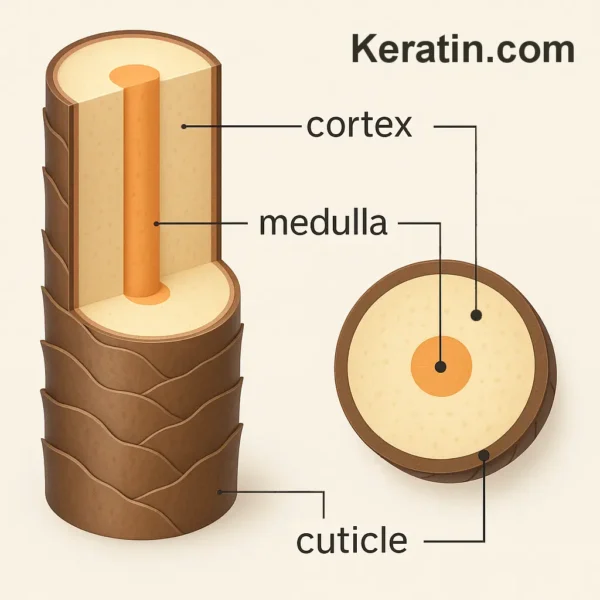
Basic structure of hair fiber: Each hair fiber consists of two, and sometimes three, primary layers: both the cuticle and cortex are present in most terminal scalp and body hairs (some people with overprocessed hair, can have most of the cuticle stripped off). Some human hairs also have a medulla, but these hairs tend to be non-pigmented and quite coarse hairs usually only seen in older people. The typical scalp hair fiber diameter is between 80-120 micrometers and hairs with a medulla are usually at the upper end of the range (If you want to know how many atoms in the cross section of a hair fiber that equates to, check out this page).
Cuticle: The outermost layer, composed of overlapping scales (keratinocyte cells), protects the inner layers of the hair. The health of the cuticle influences the hair’s shine and smoothness.
Cortex: The bulk of the hair fiber, containing fibrous proteins and the pigment melanin, which gives hair its color. The cortex is responsible for the strength and elasticity of the hair.
Medulla: The central core, which is absent in finer hair, is a loosely arranged cell structure and its function (if any) is not fully understood.
Hair chemical composition: Human hair, including all of the hair cuticle, cortex, and medulla, are made from keratin. Keratin is a fibrous protein that forms the basic structural building block of hair. In terms of “ingredients” the composition of hair can be broadly categorized into:
Proteins (Keratins): Making up approximately 95% of the hair fiber, keratins are long chains of amino acids. These proteins are high in sulfur-containing amino acids, such as cysteine, which forms disulfide bonds providing strength and resilience to the hair. Check out the amino acid composition of human hair here.
Lipids: A small portion of the hair is made up of lipids, including free fatty acids, glycerides, and cholesterol. These play a role in maintaining hair’s water retention and flexibility.
Pigments: Melanin, the primary pigment in hair, exists in two types: eumelanin (providing black or brown colors) and pheomelanin (providing red and yellow colors).
Trace Elements: Hair contains small amounts of minerals like zinc, iron, and copper, which can be indicative of nutritional status or exposure to environmental factors.
Raw element numbers: In terms of raw elements, on average, hair is composed of 50.65% carbon, 20.85% oxygen, 17.14% nitrogen, 6.36% hydrogen, and 5.0% sulfur. These numbers are a general average, the percentages can vary based on a person’s ethnicity and hair color. For example, the sulfur content was found to range from 8.8% for Irish red hair to as low as 2.3% for Scandinavian blond hair in one article. Hair also contains trace amounts of magnesium, arsenic, iron, chromium and other metals and minerals.
Keratin: The primary component of hair fiber is keratin. Keratins are proteins, long chains (polymers) of amino acids. Keratin proteins form the cytoskeleton (miniature skeleton within a cell) of all epidermal cells. Keratin filaments run within a cell from the inside of the outer membrane to weave a “basket” around the nucleus of the cell. Keratins are a principle part of the cells in the epidermis, hair, nails, feathers, hooves, horny tissues and can even be found in the enamel of teeth.
Keratin numbers: Keratin accounts for 30% of the cellular protein of living epidermal cells and 85% of cellular protein of the dead cells in the stratum corunem (the scaly, dead or horny layer of the outer skin). In hair fiber, keratin proteins comprise up to 95% of the total hair fiber by weight, though this value can go as low of 65% in some people’s hair, especially for those with chemically heavily processed hair, or for those with a genetic condition that affects keratin production. Each molecule of keratin is very small – about 10 nanometers across. To give you a sense of how small that is, 10,000 keratin molecules lined up side by side would cover the width of the average terminal scalp hair.
Keratin types: There are several subtypes of keratin proteins, some are called “soft” keratins and others are “hard” keratins. Basically, soft keratins are found in the skin and are relatively easy to break down whereas hard keratins are very resistant to degradation. Hard keratins do not dissolve in water and they are highly resistant to proteolytic enzymes. As you might have guessed, hair fiber is mostly made from hard keratin proteins.
Sulfur (sulphur): Hair contains a high amount of sulfur (or sulphur for Europeans) because the amino acid cysteine is a key component of the keratin proteins in hair fiber. The sulfur in cysteine molecules in adjacent keratin proteins link together in disulfide chemical bonds. These disulfide bonds are very strong and very difficult to break apart. These disulfide chemical bonds linking the keratins together are the key factor in the durability and resistance of hair fiber to degradation under environmental stress. They are largely resistant to the action of acids but the disulfide bonds can be broken apart by alkali solutions. This property is exploited in perms and chemical hair straightening processes. Alkali is used to break the disulfide bonds in the keratins and make the hair weak. The hair is formed into a new shape and then acid is applied to neutralize the alkali and enable the disulfide bonds to reform. The reformed disulfide bonds hold the hair in its new shape.
Keratin supplements: Some cosmetics manufacturers claim to make hair supplements, to be taken orally, that contain keratin to strengthen hair or promote hair growth. However, the cells in hair follicles make all the keratin protein that they require from amino acids supplied via the blood. Eating keratin protein does not help hair growth. Eating hard keratins as found in hair fiber is rather pointless as they cannot be broken down and absorbed. The hard keratins simply pass straight through the gut. It would be much better to eat the constituent amino acids from which the hair follicle cells can make keratin. However, it is fairly rare in North America and Western Europe to have a deficiency in amino acids so severe that it affects hair fiber quality.
Topical keratin treatments: Topically applying keratin complexes to hair can have some beneficial effect. Depending on the formulation of the treatment, keratin molecules can be small enough to get inside the hair fiber (at least the hair cuticle and perhaps the outer layers of hair cortex) and can adhere to the natural keratin already present. This can work for a while in terms of improving hair strength and quality, but it is only a temporary effect. The keratins are mostly washed away again in future shampooing processes. To have a continued effect, keratin based hair treatments need to be regularly reapplied.
Arnaud J, Bore P. Isolation of melanin pigments from human hair. J Soc Cosmet Chem. 1981;32:137–52.
1.
Wittig M. Protein patterns of keratins--the probable role in forensic hair examination. J Forensic Sci Soc. 1982 Oct;22(4):387–9.
1.
Powell BC, Rogers GE. Hair Keratin: Composition, Structure and Biogenesis. In: Bereiter-Hahn J, Matoltsy AG, Richards KS, editors. Biology of the Integument: 2 Vertebrates. Berlin, Heidelberg: Springer; 1986. p. 695–721.
1.
Rogers GE. Synthesis and cross-linking in the structure and growth of hair keratins. Clin Dermatol. 1988;6(4):26–31.
1.
Marshall RC, Orwin DF, Gillespie JM. Structure and biochemistry of mammalian hard keratin. Electron Microsc Rev. 1991;4(1):47–83.
1.
Powell BC, Rogers GE. The role of keratin proteins and their genes in the growth, structure and properties of hair. EXS. 1997;78:59–148.
1.
Baltenneck F, Bernard null, Garson JC, Engström P, Riekel C, Leroy F, et al. Study of the keratinization process in human hair follicle by X-ray microdiffraction. Cell Mol Biol (Noisy-le-grand). 2000 July;46(5):1017–24.
1.
Popescu C, Höcker H. Hair--the most sophisticated biological composite material. Chem Soc Rev. 2007 Aug;36(8):1282–91.
1.
Yang FC, Zhang Y, Rheinstädter MC. The structure of people’s hair. PeerJ. 2014 Oct 14;2:e619.
1.
Fraser RDB, Parry DAD. Structural Transition of Trichocyte Keratin Intermediate Filaments During Development in the Hair Follicle. Subcell Biochem. 2017;82:131–49.
Human hair follicle embryogenesis is a complex and tightly regulated developmental process. This biological phenomenon is governed by an intricate interplay of molecular signals, cellular…
Human hair fibers are complex biological composites engineered through a highly specialized keratinization process within the follicle. Although visually simple, a mature fiber represents one…
Hair density—commonly measured as the number of hair strands per square centimeter (hairs/cm^2)—is influenced by a variety of factors, including genetics, age, hormonal status, scalp…
Manage Cookie Consent
We use technologies like cookies to store and/or access device information. We do this to improve browsing experience and to show (non-) personalized ads. Consenting to these technologies will allow us to process data such as browsing behavior or unique IDs on this site. Not consenting or withdrawing consent, may adversely affect certain features and functions.
Functional Always active
The technical storage or access is strictly necessary for the legitimate purpose of enabling the use of a specific service explicitly requested by the subscriber or user, or for the sole purpose of carrying out the transmission of a communication over an electronic communications network.
Preferences
The technical storage or access is necessary for the legitimate purpose of storing preferences that are not requested by the subscriber or user.
Statistics
The technical storage or access that is used exclusively for statistical purposes.The technical storage or access that is used exclusively for anonymous statistical purposes. Without a subpoena, voluntary compliance on the part of your Internet Service Provider, or additional records from a third party, information stored or retrieved for this purpose alone cannot usually be used to identify you.
Marketing
The technical storage or access is required to create user profiles to send advertising, or to track the user on a website or across several websites for similar marketing purposes.