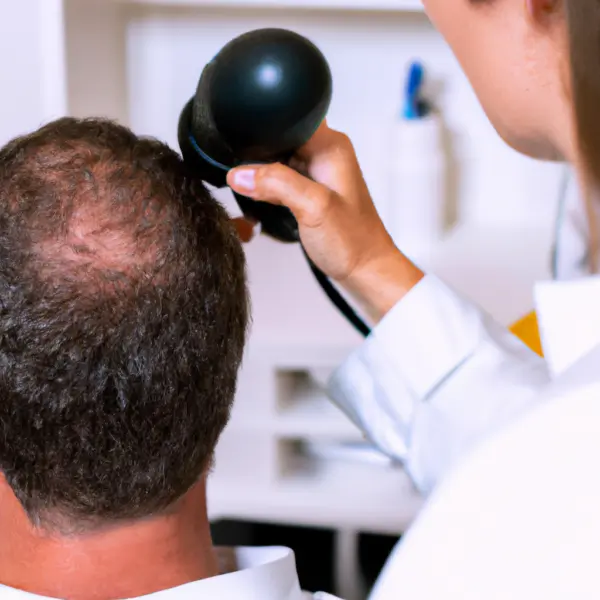
When it comes to evaluating hair loss, one of the simplest clinical procedures a dermatologist may use is the hair pull test. Despite its straightforward name and appearance, this test can offer valuable insights into the condition of the hair and scalp – if performed correctly and interpreted with caution. Below, we discuss how the hair pull test works, why it is performed, what it can (and cannot) tell us, and how clinicians can augment its accuracy with more detailed assessments.
Overview of the Hair Growth Cycle: To fully appreciate the value of the hair pull test, it helps to understand the basics of the hair growth cycle. Human scalp hair follicles cycle through three main phases:
Anagen (Growth Phase): This phase can last for several years (commonly 2–6 years), during which the hair fiber grows actively. Anagen hairs are firmly anchored and should not easily come out with gentle pulling.
Catagen (Transition Phase): This brief period, lasting a few weeks, marks a transitional time where active growth slows, and the hair follicle begins to shrink. Catagen hairs are rarely captured in a basic hair pull test because of their relatively short duration, but they do exist.
Telogen (Resting Phase): Lasting around 2–4 months, telogen marks a resting state. Telogen hairs remain in the follicle but are loosely anchored, so they can be shed with minimal force.
In a healthy scalp, the vast majority (roughly 80–90%) of hairs are in anagen; only a small percentage (5–15%) are in telogen at any given moment. This balance is crucial, because a major shift favoring more telogen hairs can lead to noticeable hair shedding and the perception of thinning.
How the Hair Pull Test Works: The basic principle of the hair pull test is extremely simple:
A dermatologist (or trained technician) selects a small group of hairs – often around 20 to 40 strands – between their thumb and forefinger.
They apply gentle traction by pulling the hair group away from the scalp.
Telogen hairs that are loosely anchored in their follicles will come out easily, whereas anagen hairs remain securely rooted.
After the pull, the dermatologist or practitioner counts how many hairs have been dislodged. By comparing the number of hairs pulled out to the total number of hairs grasped, one can get a rough percentage of how many follicles in that region are in telogen. As an example, if 2 out of 20 hairs come out, that corresponds to a 10% telogen frequency. While opinions vary, many dermatologists consider a telogen frequency around 10–15% to be normal, up to 25% to be borderline or typical of mild seasonal or stress-related shedding, and over 35% to indicate a potentially significant shift toward hair loss.
Key Advantages of the Hair Pull Test: Despite its simplicity, the hair pull test has remained a standard part of many dermatological examinations for several reasons:
Non-invasive and Quick: No scalp incisions or complex tools are required. A simple, gentle pull can be performed in seconds.
Cost-Effective: It requires no expensive equipment, making it a handy in-office screening tool.
Immediate Feedback: The dermatologist and the patient can observe the shedding pattern in real time.
Baseline Tool: It can serve as a useful baseline measure for subsequent, more detailed assessments, guiding whether further investigations are necessary.
These conveniences make the hair pull test attractive for initial evaluations. However, as with any diagnostic method, there are limitations and variables that can impact accuracy.
Limitations and Common Pitfalls: There are a number of limitations and some pitfalls to avoid when undergoing a hair pull test.
Recent Hair Washing or Grooming: Telogen hairs can be dislodged by routine shampooing, brushing, or even towel drying. If a patient has washed their hair just hours before seeing the dermatologist, many telogen hairs may have already been removed, resulting in a deceptively low telogen percentage. Conversely, if the patient has not washed their hair for several days, there may be a buildup of looser hairs, leading to an overestimation of telogen frequency. Tip: Before a scheduled hair pull test, most dermatologists advise that patients should not wash their hair within the previous 24 hours. This approach helps keep conditions as standardized as possible.
Day-to-Day Variability: Hair shedding can fluctuate daily, influenced by factors ranging from stress and hormonal changes to minor seasonal variations. A single pull test on one day is not necessarily representative of overall hair shedding patterns. Tip: Ideally, to get a more accurate snapshot, the hair pull test should be conducted daily over several days (or even a week), and the results averaged. However, logistical and practical constraints often make this approach challenging in a typical clinical setting.
Seasonal Shedding: It is a known phenomenon that many individuals experience slightly elevated shedding in the spring and fall. This seasonal shift can alter the results of a hair pull test, again underscoring the importance of context.
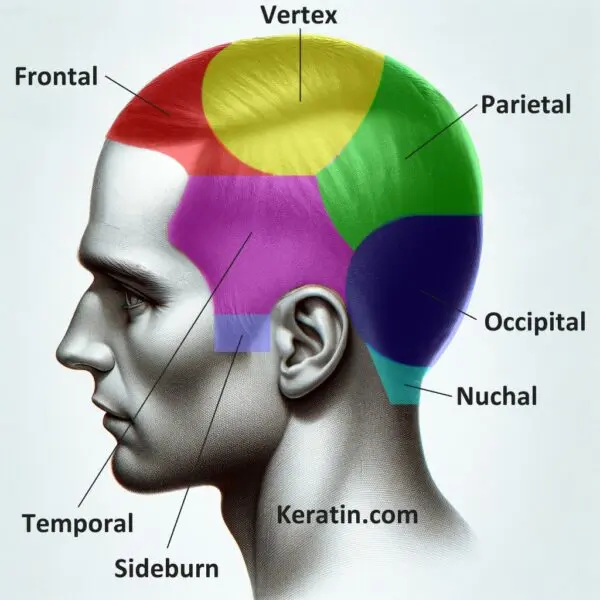
Different Regions of the Scalp: The scalp is not a uniform environment. Shedding rates can vary between the top of the scalp, the crown, the temples, and the sides. A single pull test in one area may not reflect global scalp health. If time permits, pulling small samples from multiple regions can offer a more comprehensive picture.
High Shedders vs. Low Growers: Some people are naturally “high shedders” who also grow new hair very quickly; they may appear to lose a lot of hair each day, yet still maintain a full head of hair because their anagen cycle is robust. Conversely, individuals may develop alopecia not because they are shedding more hair but because they are failing to produce new anagen hairs to replace the telogen hairs that are being lost in the normal cycle. In such cases, a normal or near-normal telogen percentage might mask the fact that anagen hairs are not replenishing the hair mass.
Interpreting Results in Context: Because of these pitfalls, professionals emphasize that the hair pull test should rarely be used in isolation. Rather, it must be interpreted alongside:
Patient history: Family history, duration and pattern of hair loss, recent stressful events, diet, and hormonal changes.
Visual inspection: Looking for thinning at certain areas, signs of inflammation, scalp conditions, or breakage.
Other diagnostics: Blood tests for nutritional deficiencies or hormonal imbalances, scalp biopsies in certain cases, and trichoscopic examinations.
If the hair pull test suggests a higher-than-normal telogen frequency, but all other signs suggest stable growth, it might be a transient phenomenon or related to a recent, correctable factor (e.g., a change in haircare routine or a recent stressful period). On the other hand, if the hair pull test is normal but the patient’s hair is visibly thinning, it could indicate an issue with anagen growth or hair shaft integrity rather than increased shedding.
Enhancing the Basic Hair Pull Test: For a more robust picture, dermatologists sometimes take a hair pull test to the next level with procedures like the “unit area trichogram.” This method involves plucking a defined number of hairs (usually with rubber-tipped forceps) from a known, measured area of the scalp. Instead of relying solely on which hairs come out passively, clinicians manually pluck all (or most) hairs in that area. They then lay these samples on a slide to assess:
Anagen vs. Telogen Counts: By microscopic examination, each hair follicle can be identified as being in anagen or telogen. This is a more direct and reliable way to quantify the percentage of telogen hairs.
Hair Fiber Diameter: The average healthy hair diameter is usually around 80 micrometers. Hairs thinner than 40 micrometers often provide very little coverage, and many “miniaturized” hairs of this caliber can indicate a common pattern of androgenetic alopecia or other conditions leading to progressive thinning.
Intermediate or Miniaturized Hairs: The presence of large numbers of thin or short hairs may signal a transition toward smaller, weaker hair follicles that yield less coverage over time.
By correlating these microscopic findings to the area of the scalp from which they were taken, dermatologists can determine both the hair’s density (hair count per square centimeter) and the proportion of hairs in different growth phases. While this procedure is more involved – and usually more expensive – it can yield significantly more reliable data than the simple hair pull test alone.
Practical Tips for Patients and Practitioners – Consistency is Key: If you plan to undergo a hair pull test, avoid washing your hair for at least 24 hours beforehand. Also, keep hair styling, brushing, and other manipulation to a minimum to avoid prematurely dislodging telogen hairs.
Repeat Measurements: Whenever possible, the test should be repeated on different days to account for natural fluctuations in shedding.
Multiple Scalp Areas: If feasible, test a few spots (front, top, crown, and sides) to get a fuller picture of your overall shedding distribution.
Understand Context and Limitations: The results should never be the final word on hair loss. Discuss with your dermatologist how the test fits into a broader diagnostic approach that may include blood work, scalp examination, and family history.
Monitor Changes Over Time: A single snapshot is less valuable than monitoring how results evolve. If your dermatologist suspects a developing issue, establishing a baseline and comparing changes over a few months can be more informative than a one-off measurement.
When the Hair Pull Test May Be Most Useful – Sudden Shedding (Telogen Effluvium): After a period of physiological stress (illness, childbirth, major surgery), a spike in the percentage of telogen hairs is common and can be confirmed with a hair pull test.
Persistent Shedding: If a patient complains of ongoing excess shedding, the test can provide a rough quantification of how many telogen hairs are being lost.
Initial Screening Tool: For early evaluations of suspected androgenetic alopecia or other hair disorders, the hair pull test can be an inexpensive way to decide if more thorough analysis is needed.
However, given its variability, the hair pull test alone should not be used to definitively diagnose complex hair conditions. Instead, it is one piece of a puzzle that includes more detailed diagnostics such as dermoscopy (trichoscopy), blood panels, and possibly scalp biopsies when indicated.
Conclusion: The hair pull test serves as a deceptively simple measure to gauge the proportion of hair follicles in the telogen phase. While the technique itself is straightforward – merely grasping a small bundle of hair and applying gentle traction – it is essential for both clinicians and patients to understand its limitations. Factors such as recent hair washing, daily variability, natural seasonal shedding, scalp location, and individual biology can all significantly influence the results.
Thus, while a quick hair pull test might help confirm a suspicion of excessive shedding or telogen effluvium, it cannot provide the entire picture of a person’s hair health. Dermatologists must interpret results within the broader context of patient history, visual examination, and, if necessary, advanced methods like the unit area trichogram. Despite these caveats, the hair pull test remains a valuable and convenient component of a hair-loss evaluation because of its simplicity, low cost, and immediacy of feedback. Ultimately, the best way to manage hair loss is to combine a thorough workup – including the hair pull test, clinical examination, patient history, and more detailed investigations if needed – to arrive at an accurate diagnosis. From there, appropriate treatments or lifestyle adjustments can be recommended. When used properly, the hair pull test acts as a starting point, helping guide further steps and ensuring that interventions are tailored to each individual’s unique scalp and hair growth dynamics.
Rushton H, James KC, Mortimer CH. The unit area trichogram in the assessment of androgen-dependent alopecia. Br J Dermatol. 1983 Oct;109(4):429–37.
1.
Guarrera M, Semino MT, Rebora A. Quantitating hair loss in women: a critical approach. Dermatology. 1997;194(1):12–6.
1.
Rampini P, Guarrera M, Rampini E, Rebora A. Assessing hair shedding in children. Dermatology. 1999;199(3):256–7.
1.
Olsen EA, Bettencourt MS, Coté NL. The presence of loose anagen hairs obtained by hair pull in the normal population. J Investig Dermatol Symp Proc. 1999 Dec;4(3):258–60.
1.
Mirmirani P, Huang KP, Price VH. A practical, algorithmic approach to diagnosing hair shaft disorders. Int J Dermatol. 2011 Jan;50(1):1–12.
1.
McDonald KA, Shelley AJ, Colantonio S, Beecker J. Hair pull test: Evidence-based update and revision of guidelines. J Am Acad Dermatol. 2017 Mar;76(3):472–7.
1.
Park SH, Seol JE, Kim DH, Kim H. Analysis of Microscopic Examination of Pulled Out Hair in Telogen Effluvium Patients. Ann Dermatol. 2020 Apr;32(2):141–5.
1.
Tsiogka A, Laimer M, Ahlgrimm-Siess V. Trichoscopy-assisted hair pull test: A helpful adjunct to trichoscopy for diagnosing and managing alopecias. Australas J Dermatol. 2021 Nov;62(4):e602–5.
1.
McDonald KA, Shelley AJ, Maliyar K, Abdalla T, Beach RA, Beecker J. Hair pull test: A clinical update for patients with Asian- and Afro-textured hair. J Am Acad Dermatol. 2021 Dec;85(6):1599–601.
The human scalp is a complex and vital area of the body, especially when considering hair and skin health. For healthcare professionals, particularly those specializing…
The hair wash test is a helpful diagnostic tool in trichology, offering clinicians and researchers a quantitative method to assess hair shedding. This test involves…
Manage Cookie Consent
We use technologies like cookies to store and/or access device information. We do this to improve browsing experience and to show (non-) personalized ads. Consenting to these technologies will allow us to process data such as browsing behavior or unique IDs on this site. Not consenting or withdrawing consent, may adversely affect certain features and functions.
Functional Always active
The technical storage or access is strictly necessary for the legitimate purpose of enabling the use of a specific service explicitly requested by the subscriber or user, or for the sole purpose of carrying out the transmission of a communication over an electronic communications network.
Preferences
The technical storage or access is necessary for the legitimate purpose of storing preferences that are not requested by the subscriber or user.
Statistics
The technical storage or access that is used exclusively for statistical purposes.The technical storage or access that is used exclusively for anonymous statistical purposes. Without a subpoena, voluntary compliance on the part of your Internet Service Provider, or additional records from a third party, information stored or retrieved for this purpose alone cannot usually be used to identify you.
Marketing
The technical storage or access is required to create user profiles to send advertising, or to track the user on a website or across several websites for similar marketing purposes.