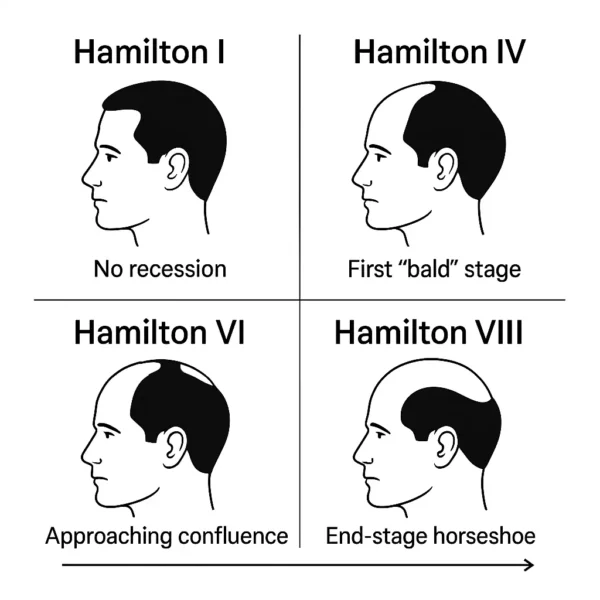
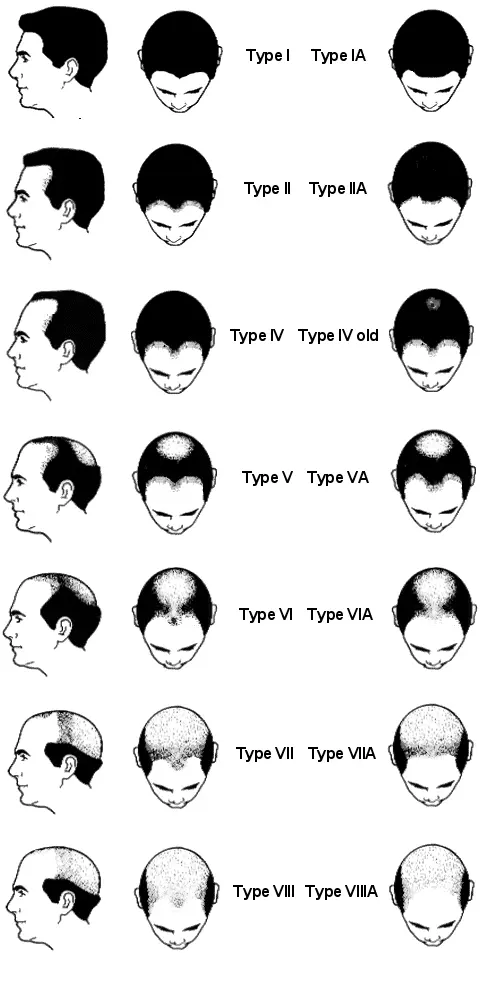
In 1951, anatomist James B. Hamilton proposed the first broadly usable scheme for grading the extent of male pattern baldness (androgenetic alopecia, AGA). He organized scalp changes into eight types (I–VIII) plus several variants, creating a common language for clinicians and researchers to describe where hair is being lost and how far the process has progressed. Hamilton’s work drew on clinic-based observations of hundreds of adults and remains the historical foundation for all modern systems-including the widely used Norwood (1975) modification.
Who Hamilton studied and why it mattered: Hamilton’s classification emerged from systematic examination of Caucasian men and women across the adult lifespan. Contemporary summaries of his cohort note that he examined 312 men and 214 women aged 20–89 years to construct the scale and its reference drawings. By explicitly including women, Hamilton also documented sex differences in patterning and age-related prevalence, even though the scheme was designed primarily around male patterns.
Beyond offering a descriptive vocabulary, Hamilton’s scale aimed to be practical and reproducible. In one demonstration, four lay attendants, given only his sketches and brief descriptions, independently classified 125 subjects with ~98% agreement with Hamilton’s own ratings. He also showed strong test–retest reliability, reproducing the same grade in 199 of 200 patients over a 3-month interval. These simple but persuasive exercises helped establish the system’s clinical utility in the mid-20th century.
How the Hamilton scale is organized: Hamilton divided scalps into “not bald” (Types I–III) and “bald” (Types IV–VIII), with “A” variants to capture linear anterior recession (“A” for “anterior”) in some stages. Several anatomic landmarks anchor the descriptions, notably the midcoronal line (a coronal plane through both external auditory meatuses). The stages can be summarized as follows (condensed from Hamilton’s descriptions and later clinical reviews):
Type I – No hair loss. No bilateral recessions along the anterior hairline in the frontoparietal region. A variant, Type IA, covers individuals with a congenitally high hairline but no recession.
Type II – Early bitemporal recession. Triangular recessions appear at the frontoparietal hairline but do not extend to within 3 cm of the midcoronal line. The mid-frontal border may thin slightly but remains relatively preserved.
Type III – Borderline/atypical cases. A “basket” category for asymmetric, scar-related, or otherwise hard-to-classify presentations (rare; Hamilton did not depict it in his canonical plate set).
Type IV – Minimum level qualifying as “bald.” Deeper triangular recessions extend beyond the 3 cm threshold toward the midcoronal line; the mid-frontal zone usually thins. Type IVA denotes a broad band of frontal loss along the anterior hairline rather than sharply triangular recessions. In older individuals, vertex thinning may also appear (“Type IV old”).
Type V – Frontal and vertex involvement. More severe frontoparietal recession than Type IV, with a separate balding focus on the crown (vertex).
Type VI – Approaching confluence. From above, the frontal recession resembles a horseshoe, with a small “island” of mid-frontal hair remaining; the vertex bald patch is larger but still separate. Type VIA indicates further loss/sparsening of that mid-frontal island.
Types VII–VIII – Most advanced. Frontal and vertex balding coalesce; only a peripheral “horseshoe” fringe remains. Hamilton distinguished Type VII vs VIII by the presence in VIII of ≥ 100 coarse terminal hairs persisting within the otherwise bald zone and by a larger denuded area overall.
Together these categories capture the characteristic trajectory of male pattern hair loss: bitemporal recession and mid-frontal thinning, progressive expansion of vertex loss, and eventual confluence of frontal and vertex balding with preservation of parietal–occipital fringes.
What Hamilton observed about age and sex: Hamilton emphasized that some anterior hairline change after puberty is nearly universal. In his analyses, Type I (prepubertal pattern) gives way to Type II after sexual maturation in the large majority of people. Summaries of his data report that ~96% of men and ~79% of women show at least Type II configuration once puberty is complete, reflecting the “mature” hairline rather than frank balding. He also reported that by age ≥ 50, about 58% of men exhibited Types V–VIII patterns, with severity increasing until ~70 years; among women, roughly 25% reached Type IV by age 50, with little additional progression thereafter and virtually no women reaching Types V–VIII in his material. These observations helped separate normal maturational changes from clinically significant baldness.
Strengths: Hamilton’s scheme was:
Anatomically explicit. Landmarks (e.g., the midcoronal line) made cut-points reproducible.
Clinically usable. Even non-experts could apply it reliably after brief exposure, and Hamilton showed high test–retest consistency.
Graded yet comprehensive. The eight main types and “A” variants mapped both anterior recession and vertex loss-the two axes along which AGA typically evolves.
Limitations: Two design choices later drew criticism:
Type III as a “miscellaneous” bucket, which can reduce clarity when borderline or asymmetric cases are shoehorned into a single group.
Complexity (eight types plus variants) that some clinicians found hard to memorize, prompting later simplifications and retraining when alternative schemes were introduced.
Hamilton vs. Norwood and later systems: In 1975, O’tar Norwood streamlined Hamilton’s categories into a seven-stage system with explicit “Type A” variants for linear anterior recession without early vertex involvement. Norwood removed Hamilton’s Type III “basket” category and redrew the plates with clearer pictorial distinctions, which helped adoption in surgical practice and clinical trials. Despite its popularity, inter-rater agreement for the Norwood–Hamilton scheme has been variable, spurring further tweaks (e.g., adapted Norwood–Hamilton). Still, Hamilton’s anatomical logic-tracking frontal and vertex components and their eventual confluence-underpins all descendants.
How to use Hamilton’s framework today: Although most clinics now speak in Norwood–Hamilton shorthand, Hamilton’s original system remains instructive for:
Historical comparisons in literature predating 1975.
Fine-grained anatomic description, especially when distinguishing early maturing hairlines (Type II) from pathological balding (Types IV–VIII).
Research stratification, where distinguishing anterior-predominant (“A” variants) from vertex-predominant patterns can be biologically and therapeutically meaningful.
Bottom line: Hamilton’s 1951 classification provided the first systematic, reproducible way to document male pattern baldness across its natural history, from the prepubertal Type I scalp to the confluent late patterns of Types VII–VIII. His careful definitions, pragmatic validation, and age/sex observations created a vocabulary that clinicians still use-directly or through Norwood’s refinements to stage disease, counsel patients, and compare outcomes. Even as newer schemas aim for better inter-rater reliability or broader applicability, the Hamilton framework remains the conceptual blueprint for understanding how AGA begins, advances, and ultimately converges across the scalp.
Here’s a concise side-by-side that maps Hamilton (I–VIII) to Norwood (I–VII), with the common clinical cut off points clinicians use when staging male pattern hair loss.
Hamilton stage
Norwood equivalent
Key features (summary)
Common clinical cut-off points / notes
I
I
No recession at the frontoparietal hairline.
Fully haired pattern; not “bald.”
IA
(no single exact match; closest is I or IIA)
Congenitally high hairline without recession.
In Norwood, may be recorded as I (no recession) or IIA if there is anterior hairline movement without bitemporal recessions.
II
II
Early triangular bitemporal recessions that do not extend to within ~3 cm of the mid-coronal line.
“Mature hairline”; still not considered bald.
III (misc./atypical)
(none; removed in Norwood)
Basket for asymmetric/atypical cases.
Norwood eliminated this category; atypical cases are assigned to the closest stage.
IV
III (incl. III Vertex)–IV
Deeper frontoparietal recession; frontal thinning band. In older individuals, vertex thinning can appear (“Type IV old”).
First “bald” stage in Hamilton. In Norwood, III is typically the first “bald” stage; III Vertex marks the first vertex involvement.
V
IV
Advanced frontal recession plus a separate vertex bald spot; bridge of hair between regions still substantial.
Clear frontal + vertex pattern with a preserved bridge.
VI (incl. VIA)
V
Larger vertex area; frontal recession resembles a “horseshoe” from above; small mid-frontal “island” may persist (VIA when further thinned).
Approaching confluence; the bridge narrows.
VII
VI
Confluence of frontal and vertex areas; bridge essentially lost; peripheral horseshoe remains.
Frontal–vertex confluence is the key cut-point for Norwood VI.
VIII
VII
Most extensive loss; only a narrow occipital–parietal fringe remains; Hamilton noted ≥100 coarse terminal hairs may persist within the denuded zone.
“Horseshoe only” pattern; Norwood VII.
About “Type A” variants:
Hamilton “A” variants (e.g., IVA, VIA) denote predominant anterior hairline recession with comparatively less vertex change for that stage.
Norwood “Type A” series (IIA, IIIA, IVA, VA) likewise indicate linear anterior migration of the hairline without early vertex involvement. Rough mapping: Hamilton IVA ≈ Norwood IIIA/IVA, Hamilton VIA ≈ Norwood VA, acknowledging some stage-to-stage overlap.
Practical cut-points many clinics use:
Not bald vs bald: Hamilton IV+ and Norwood III+ are generally treated as “balding” rather than physiologic maturation.
First vertex signal: Hamilton V (often IV-old) and Norwood III Vertex.
Confluence of frontal and vertex: Hamilton VII and Norwood VI.
End-stage horseshoe: Hamilton VIII and Norwood VII.
Hamilton JB. Patterned loss of hair in man; types and incidence. Ann N Y Acad Sci. 1951 Mar;53(3):708–28.
1.
Norwood OT. Male pattern baldness: classification and incidence. South Med J. 1975 Nov;68(11):1359–65.
1.
Dawber RP. Aetiology and pathophysiology of hair loss. Dermatologica. 1987;175 Suppl 2:23–8.
1.
Wirya CT, Wu W, Wu K. Classification of Male-pattern Hair Loss. Int J Trichology. 2017;9(3):95–100.
1.
Washenik K. 7 Pathogenesis and Classification of Male Pattern Hair Loss (Androgenic Alopecia). In: Hair Transplantation. 6. Edition. Thieme Verlag; 2023. p. 36–9.
Title: The Role of Integrins in Androgenetic Alopecia: A Comprehensive Review Androgenetic alopecia (AGA) is a common form of hair loss that affects both men…
Female pattern hair loss, also known as androgenetic alopecia, is a common condition typically associated with women, characterized by a diffuse thinning of hair on…
Introduction: Pattern hair loss, a common condition impacting millions globally, can profoundly affect an individual’s self-esteem and quality of life (QoL). While the causes of…
Manage Cookie Consent
We use technologies like cookies to store and/or access device information. We do this to improve browsing experience and to show (non-) personalized ads. Consenting to these technologies will allow us to process data such as browsing behavior or unique IDs on this site. Not consenting or withdrawing consent, may adversely affect certain features and functions.
Functional Always active
The technical storage or access is strictly necessary for the legitimate purpose of enabling the use of a specific service explicitly requested by the subscriber or user, or for the sole purpose of carrying out the transmission of a communication over an electronic communications network.
Preferences
The technical storage or access is necessary for the legitimate purpose of storing preferences that are not requested by the subscriber or user.
Statistics
The technical storage or access that is used exclusively for statistical purposes.The technical storage or access that is used exclusively for anonymous statistical purposes. Without a subpoena, voluntary compliance on the part of your Internet Service Provider, or additional records from a third party, information stored or retrieved for this purpose alone cannot usually be used to identify you.
Marketing
The technical storage or access is required to create user profiles to send advertising, or to track the user on a website or across several websites for similar marketing purposes.