Alopecia areata (AA), a condition characterized by sudden hair loss in patches, has a long-standing history, with descriptions seemingly present in ancient texts and visual arts. This article endeavors to explore the early history of this condition, tracing its roots from ancient civilizations to the modern scientific understanding we have today.
The earliest potential reference to AA can be traced back to the ancient Vedas (5000-400 BCE) of Ayurvedic medicine. However, confirming this with certainty is challenging due to the chronological ambiguity of these texts. A more definitive historical record of AA appears in the “Ebers Papyrus,” the most comprehensive record of ancient Egyptian medicine known to date, believed to be from around 1500 BCE. This papyrus, found nestled between the feet of an Egyptian mummy, primarily lists medical treatments for use in the afterlife. Within the text, a condition termed “Nssq,” which indicates hair loss, is mentioned. It is believed this term refers to patchy AA, providing the earliest reasonable evidence of this condition.
The Greek physician Hippocrates (~400 BCE) briefly mentioned hair afflictions in his book “On Diseases.” He referred to areas where the hair was “foxy” (from the Greek αλώπηξ = alopex, meaning fox’s disease, alopecia), potentially alluding to mange. It remains unclear, however, if he was describing AA or androgenetic alopecia.
In ancient Chinese texts, the Yellow Emperor Huang Ti (2696-2595 BCE) suggested that hair could fall out due to imbalanced dietary practices. These writings may also refer to AA, although it is not entirely clear.
The first unmistakable descriptions of AA are credited to Cornelius Celsus (25 BCE – 50 CE), a Roman translator of medical works. In his work “De Medicina,” he described “Alopekia,” bald spots appearing on the scalp and beard, and “Ophiasis,” bald areas spreading in a pattern reminiscent of a winding snake.
The Italian physician Girolamo Mercuriale (1530-1606) later echoed these ancient descriptions in his book “De Morbis Cutaneis” in 1572, considered the first “modern” scientific treatise on skin diseases. He discussed AA in much the same way as the ancient Greek transcripts, even outlining treatments for the condition.
The field of dermatology, however, saw very little change in the presentation and treatment of AA for approximately 1500 years. The works of Hippocrates, Celsus, and Galen remained the primary sources of information.
The first “modern” description of AA is attributed to Thomas Bateman (1778-1821) and Robert Willan (1757-1812). Willan pioneered a system for classifying skin diseases based on their appearance rather than symptoms. After Willan’s death, Bateman continued his work and, in 1813, published “A Practical Synopsis of Cutaneous Diseases According to the Arrangement of Dr Willan.” Bateman described AA in detail, shedding light on its distinctive patchy characteristics.
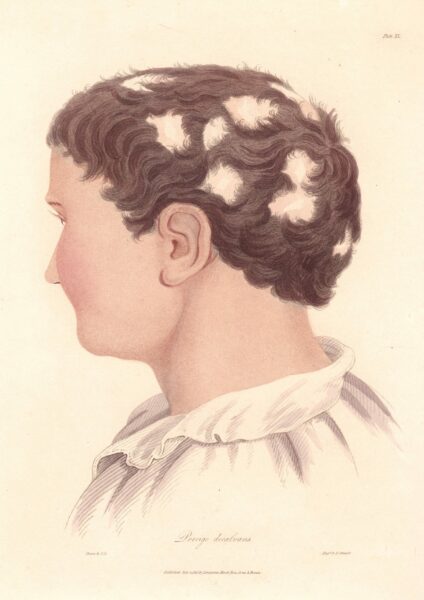
The first potential visual representation of AA can be seen in the 1480 painting “Saint Sebastian” by Andrea Mantegna, where the bowman might have alopecia barbae, a variant of AA affecting the beard. The first dermatology atlas to show AA, “the Delineations of Cutaneous Disease,” was published in 1817, featuring a hand-colored engraving of a male with multiple AA patches. In 1868, the first photographic depiction of AA was published, showing a young boy with extensive AA.
In conclusion, alopecia areata (AA) has a long and intricate history, woven into the fabric of ancient medical literature and art. Its early depictions in the Vedas, Ebers Papyrus, and the writings of Hippocrates and Celsus lay the groundwork for our understanding of this condition. As medical knowledge evolved, so too did our interpretation of AA, with the works of Mercuriale, Bateman, and Willan, pushing forward the clinical understanding of the disease.
Moreover, AA’s representation in visual art and medical illustrations provides a compelling testament to its pervasive presence throughout human history. From the potential depiction in Mantegna’s painting to the detailed illustrations in the 19th-century dermatology atlas, these visual records have immortalized the condition, offering a unique perspective that transcends textual descriptions.
The journey of understanding AA has been one of gradual revelation, with each generation adding to our collective knowledge. This journey serves as a reminder that the progression of medical understanding is a continuous process. It underlines the importance of historical knowledge in guiding current and future research efforts in the hope of finding more effective treatments and, ultimately, a cure for conditions like AA.
Bateman T, Willan R. Delineations of Cutaneous Diseases: Exhibiting the Characteristic Appearances of the Principal Genera and Species Comprised in the Classification of the Late Dr. Willan and Completing the Series of Engravings Begun by that Author. Longman, Hurst, Rees, Orme, and Brown; 1817. 374 p.
1.
Bateman T. A Practical Synopsis of Cutaneous Diseases: According to the Arrangement of Dr. Willan. Longman, Rees, Orme, Brown & Green; 1829. 512 p.
1.
Ebers G [Hrsg. Papyros Ebers: Das Hermetische Buch über die Arzneimittel der alten Ägypter in hieratischer Schrift. Leipzig; 1875.
1.
Borroni G. Alopecia Areata and Moral Judgment in the History of Art. The American Journal of Dermatopathology. 1992 Apr;14(2):170.
1.
Broadley D, McElwee KJ. A “hair-raising” history of alopecia areata. Exp Dermatol. 2020 Mar;29(3):208–22.
Alopecia areata (AA), a condition characterized by the sudden loss of hair in patches, often first manifests in individuals during their late teens to early…
In the annals of medical history, particularly within the rich tapestry of ancient Chinese culture, the condition we now recognize as alopecia areata was once…
Introduction: Celiac disease (CD) is an autoimmune disorder characterized by an inappropriate immune response to gluten, a protein found in wheat, barley, and rye. This…
Manage Cookie Consent
We use technologies like cookies to store and/or access device information. We do this to improve browsing experience and to show (non-) personalized ads. Consenting to these technologies will allow us to process data such as browsing behavior or unique IDs on this site. Not consenting or withdrawing consent, may adversely affect certain features and functions.
Functional Always active
The technical storage or access is strictly necessary for the legitimate purpose of enabling the use of a specific service explicitly requested by the subscriber or user, or for the sole purpose of carrying out the transmission of a communication over an electronic communications network.
Preferences
The technical storage or access is necessary for the legitimate purpose of storing preferences that are not requested by the subscriber or user.
Statistics
The technical storage or access that is used exclusively for statistical purposes.The technical storage or access that is used exclusively for anonymous statistical purposes. Without a subpoena, voluntary compliance on the part of your Internet Service Provider, or additional records from a third party, information stored or retrieved for this purpose alone cannot usually be used to identify you.
Marketing
The technical storage or access is required to create user profiles to send advertising, or to track the user on a website or across several websites for similar marketing purposes.