Traction alopecia (TA) is a form of hair loss that is predominantly seen in individuals with tightly pulled hairstyles, which puts prolonged tension on the hair shafts and follicles. This condition is particularly prevalent among patients of color, affecting up to one-third of adult women and one-fourth of adolescents and teenagers of African descent. The tension and pulling caused by certain hairstyles lead to damage to the hair shaft and follicle, ultimately causing hair loss.
TA can be categorized into three main subtypes: anterior hairline, ophiasis pattern, and patchy. Anterior hairline TA, the most commonly reported type, is characterized by symmetric hair loss along the frontotemporal hairline. Sometimes, alopecia with retained hairs along the periphery of the marginal hairline, known as the “fringe sign”, may be present. Another characteristic is the flambeau sign, which presents as linear white tracks on dermoscopy resembling a lit torch in the direction of the hair pull.
Ophiasis pattern TA is similar to the anterior hairline TA but is located along the posterior (at the back of the head) and parietal scalp (the region between temples and occipital scalp). This subtype is often associated with up-do hairstyles such as ponytails, buns, and braids, which create tension on the posterior part of the scalp. Retained peripheral hairs, similar to the fringe sign, are commonly present.
Patchy TA is characterized by ill-defined areas of decreased density throughout the scalp due to recurrent tension in a particular pattern or direction. It is often seen with hairstyles such as locks and recurrent tight braids and may also be associated with the use of hair rollers, hair clips, and other hair accessories.
Diagnosis of traction alopecia is primarily based on clinical findings of hair loss in areas of tension. However, it is crucial to distinguish TA from other types of alopecia. In early stages, TA can mimic conditions like trichotillomania and alopecia areata due to the presence of non-scarring alopecia and broken hairs. In later stages, TA presents with smooth hairless patches, which need to be distinguished from scarring alopecias like frontal fibrosing alopecia (FFA) and patchy central centrifugal cicatricial alopecia (CCCA).
In the pediatric population, the differential diagnosis includes temporal triangular alopecia, alopecia areata, trichotillomania (hair plucking), and tinea capitis (ringworm). Distinctive features on clinical examination, trichoscopy, and pathology are essential for the correct diagnosis. For example, frontal fibrosing alopecia lacks the fringe sign and has a presence of single lonely terminal hairs, while alopecia areata may be distinguished by exclamation-point hairs on dermoscopy and a history of sudden onset.
An important tool used in evaluating the severity of traction alopecia is the Marginal Traction Alopecia Severity Score (M-TAS), a validated photographic scale. The M-TAS assesses the severity of marginal TA by grading the anterior and posterior hairlines on a scale of 0 to 9 based on anatomic landmarks. This scale has been used in clinical studies to correlate disease severity with potential risk factors for TA, and it may also be used to monitor response to treatment. Dermoscopy is another valuable diagnostic aid, where the presence of hair casts is typical of traction alopecia. In patchy and marginal types of TA, a reduction in the density of hair follicles, the absence of follicular openings, and the presence of a large number of freely mobile hair casts at the periphery of the patch is seen with dermoscopy.
In conclusion, traction alopecia is a significant hair loss condition primarily due to hairstyles that exert prolonged tension on the hair. Early diagnosis and intervention are critical to managing and preventing further progression of this condition. Understanding the different subtypes and their presentation, as well as using tools such as the M-TAS and dermoscopy, are essential for accurate diagnosis and treatment. Additionally, educating individuals on the risks associated with certain hairstyles and promoting hair care practices that reduce tension on the hair can be pivotal in preventing traction alopecia. Especially in communities where the prevalence of TA is high, such as among women and adolescents of African descent, awareness and preventive measures are integral to combating this condition. Moreover, healthcare professionals should be cognizant of the various presentations and mimickers of traction alopecia to ensure timely and appropriate intervention. Through a combination of awareness, preventive measures, and early intervention, the impact of traction alopecia on affected individuals can be significantly mitigated.
Khumalo NP, Ngwanya RM, Jessop S, Gumedze F, Ehrlich R. Marginal traction alopecia severity score: development and test of reliability. J Cosmet Dermatol. 2007 Dec;6(4):262–9.
1.
Billero V, Miteva M. Traction alopecia: the root of the problem. Clin Cosmet Investig Dermatol. 2018;11:149–59.
1.
Mayo TT, Callender VD. The art of prevention: It’s too tight-Loosen up and let your hair down. Int J Womens Dermatol. 2021 Mar;7(2):174–9.
1.
Afifi L, Oparaugo NC, Hogeling M. Review of traction alopecia in the pediatric patient: Diagnosis, prevention, and management. Pediatr Dermatol. 2021 Nov;38 Suppl 2:42–8.
1.
Larrondo J, McMichael AJ. Traction Alopecia. JAMA Dermatol. 2023 June 1;159(6):676.
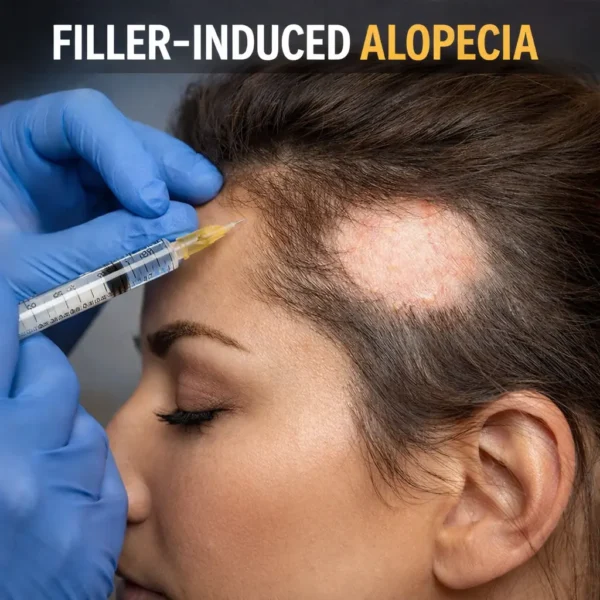
Why are dermal fillers suddenly linked to hair loss: Soft‑tissue fillers – particularly hyaluronic‑acid (HA) gels – have become a mainstay of minimally invasive cosmetic…
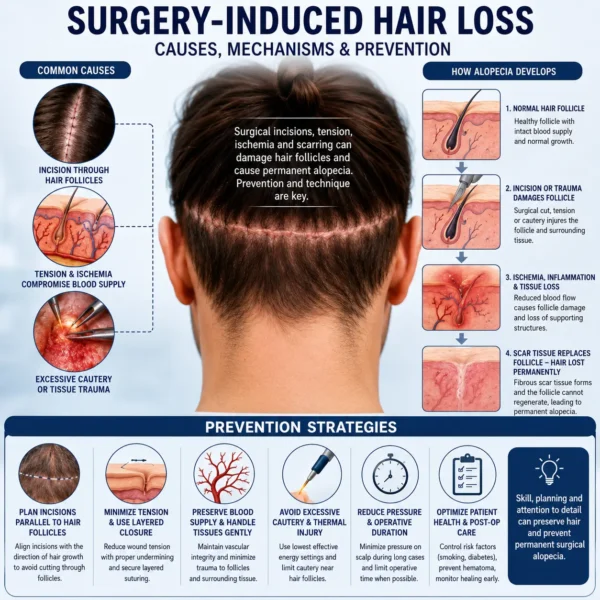
Hair loss after surgery is an under-recognized but clinically important complication. It may present as transient diffuse shedding or as permanent, localized alopecia confined to…
Manage Cookie Consent
We use technologies like cookies to store and/or access device information. We do this to improve browsing experience and to show (non-) personalized ads. Consenting to these technologies will allow us to process data such as browsing behavior or unique IDs on this site. Not consenting or withdrawing consent, may adversely affect certain features and functions.
Functional Always active
The technical storage or access is strictly necessary for the legitimate purpose of enabling the use of a specific service explicitly requested by the subscriber or user, or for the sole purpose of carrying out the transmission of a communication over an electronic communications network.
Preferences
The technical storage or access is necessary for the legitimate purpose of storing preferences that are not requested by the subscriber or user.
Statistics
The technical storage or access that is used exclusively for statistical purposes.The technical storage or access that is used exclusively for anonymous statistical purposes. Without a subpoena, voluntary compliance on the part of your Internet Service Provider, or additional records from a third party, information stored or retrieved for this purpose alone cannot usually be used to identify you.
Marketing
The technical storage or access is required to create user profiles to send advertising, or to track the user on a website or across several websites for similar marketing purposes.