Hair growth is a normal physiological process that varies widely among individuals based on genetic, hormonal, and environmental factors. However, certain conditions can lead to excessive hair growth, creating aesthetic and medical concerns. Among these conditions are hirsutism and hypertrichosis, terms often used interchangeably, but fundamentally different in their definitions and their implications for disease and disorder diagnosis and treatment.
Hirsutism: Excess Male-Pattern-Type Hair Growth in Women or Children
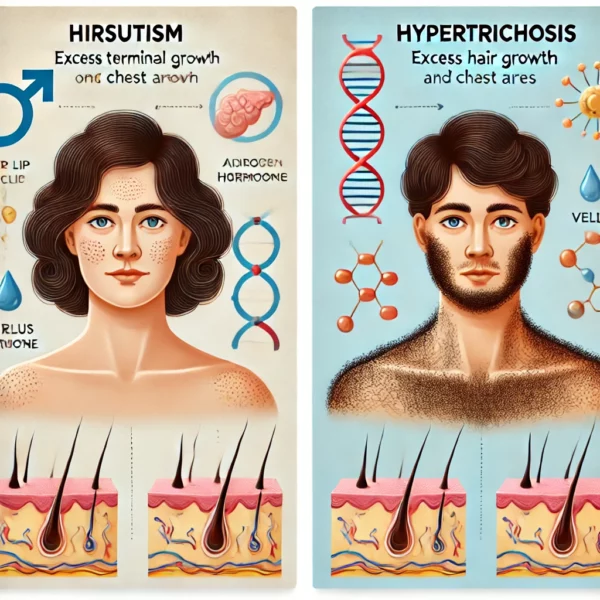
Hirsutism is characterized by excessive terminal hair growth in women in areas where men typically grow hair, such as the upper lip, chin, chest, back, and abdomen. This pattern of hair growth is primarily influenced by androgenic hormones, such as testosterone, which are present in both men and women, but in different concentrations.
Key Characteristics of Hirsutism:
Pattern: The hair growth follows a male distribution pattern.
Type of Hair: The excess hair is typically terminal, meaning it is coarse and pigmented.
Population: Primarily affects women, but can also occasionally affect boys and girls pre-puberty.
Hormonal Influence: Often associated with increased levels of androgens or heightened sensitivity of hair follicles to androgens, or a loss of androgen antagonists including estrogens.
Associated Conditions: Polycystic ovary syndrome (PCOS), adrenal hyperplasia, certain drug medications, tumors secreting androgens, some skin treatments incorporating placenta extracts, etc.
Hirsutism can significantly impact a woman’s quality of life, affecting her self-esteem and social interactions. Diagnosis typically involves a thorough medical history, physical examination, and possibly laboratory tests to measure hormone levels and identify underlying conditions.
Hypertrichosis: Generalized Excess Hair Growth
Hypertrichosis refers to excessive hair growth that is above the normal range for a person’s age, sex, and race. Unlike hirsutism, hypertrichosis can affect any part of the body and is not confined to areas where men typically grow hair. Hypertrichosis can be categorized into two main types: congenital and acquired.
Congenital Hypertrichosis:
Definition: Excessive hair growth visible at birth or growing very shortly after birth.
Distribution: Can affect the entire body or be localized to specific areas of skin.
Type of Hair: May involve fine lanugo hair, which is typically shed before birth, or coarser terminal hair.
Causes: Often associated with genetic syndromes, such as Ambras syndrome or congenital hypertrichosis lanuginosa.
Acquired Hypertrichosis:
Definition: Excessive hair growth that develops some time after birth.
Distribution: Can be generalized all over the body or localized to specific areas of skin.
Type of Hair: Typically involves long vellus hair when covering the entire body, which is fine and unpigmented, but can also include terminal hair, particularly when it occurs in a limited area of skin.
Causes: A wide range of factors, including systemic drug medications (e.g., minoxidil, cyclosporine), systemic diseases (e.g., hyperthyroidism, anorexia nervosa), malignancies, skin cancers, porphyrias, topical drug treatments, chronic skin irritation, etc.
Differences between Hirsutism and Hypertrichosis
While both conditions involve excessive hair growth, their differences are essential to understand for accurate diagnosis and treatment:
Pattern and Distribution:
Hirsutism: Male-pattern hair growth in women or young children, confined to androgen-sensitive areas (upper lip, chin, chest, back, and abdomen).
Hypertrichosis: Generalized or localized hair growth that can affect any area of the body and doesn’t show an obvious male-pattern distribution.
Hormonal Influence:
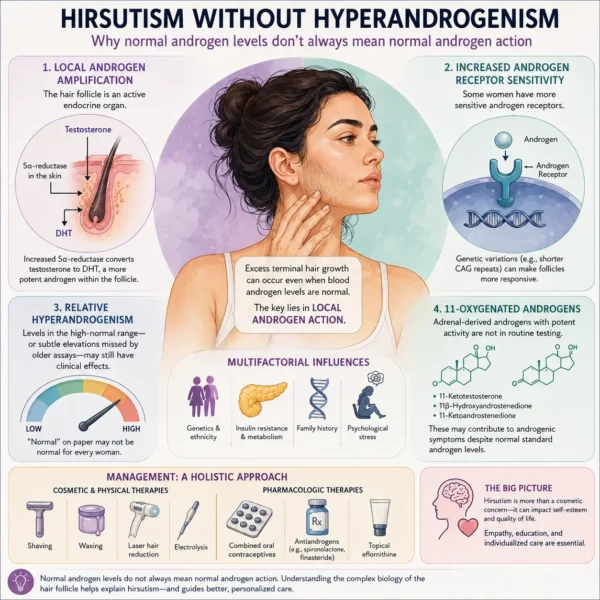
Hirsutism: Strongly linked to androgen levels and hormonal imbalances. Not all women may have elevated androgen hormones. In these cases, it is believed that androgen antagonists, such as estrogens, may be dysfunctional, and/or hair follicles are overly sensitive to androgen hormones.
Hypertrichosis: Not directly associated with androgen hormones; can result from various other factors, including other kinds of hormones.
Hirsutism: Almost exclusively affects women and very rarely children.
Hypertrichosis: Can affect men, women and children, and can first occur at any age.
Causes and Classifications of Hypertrichosis
Understanding the causes and classifications of hypertrichosis is essential for clinicians to diagnose and manage the condition effectively.
Congenital Hypertrichosis:
Genetic Syndromes: Congenital hypertrichosis is most often a symptom of genetic conditions like Ambras syndrome, characterized by excessive lanugo hair covering large areas of the body. Congenital hypertrichosis lanuginosa involves a similar presentation but without the syndromic features.
Non-Syndromic Cases: Some cases of congenital hypertrichosis can occur without any associated syndromes, presenting as isolated findings of excessive hair growth.
Acquired Hypertrichosis:
Medications: Certain drugs can induce hypertrichosis as a side effect. For example, oral minoxidil, used to treat hypertension and hair loss, can cause generalized body hair growth.
Systemic Diseases: Conditions such as hyperthyroidism, where metabolic rates are elevated, can lead to increased hair growth. Hair follicles also have receptors to some thyroid hormones so there may also be a direct hair growth promoting effect.
Malignancies and Paraneoplastic Syndromes: Some cancers can produce and secrete substances that stimulate hair growth, resulting in hypertrichosis.
Nutritional Deficiencies and Disorders: Anorexia nervosa can lead to hypertrichosis as the body reacts to severe malnutrition by producing fine vellus hair to conserve heat.
Clinical Management
The management of hirsutism and hypertrichosis involves addressing the underlying causes and considering cosmetic and medical treatments to reduce the impact of excessive hair growth.
Hirsutism Management:
Hormonal Treatments: Oral contraceptives, anti-androgens (such as spironolactone), and insulin sensitizers (for PCOS-related hirsutism).
Cosmetic Procedures: Laser hair removal, electrolysis, hair bleaching, eflornithine, etc.
Hypertrichosis Management:
Addressing Underlying Causes: Discontinuing causative medications, treating systemic diseases, etc.
Cosmetic Procedures: Similar to those used for hirsutism, including shaving, waxing, and depilatory creams.
In conclusion, while hirsutism and hypertrichosis both involve excessive hair growth, their differences in pattern, hormonal influence, and affected populations necessitate distinct diagnostic and therapeutic approaches. Understanding these differences is crucial for effective clinical management and improving patient outcomes.
Azziz R, Carmina E, Sawaya ME. Idiopathic hirsutism. Endocr Rev. 2000 Aug;21(4):347–62.
1.
Trüeb RM. Causes and management of hypertrichosis. Am J Clin Dermatol. 2002;3(9):617–27.
1.
Wendelin DS, Pope DN, Mallory SB. Hypertrichosis. J Am Acad Dermatol. 2003 Feb;48(2):161–79; quiz 180–1.
1.
Rosenfield RL. Hirsutism and the variable response of the pilosebaceous unit to androgen. J Investig Dermatol Symp Proc. 2005 Dec;10(3):205–8.
1.
Rosenfield RL. Clinical practice. Hirsutism. N Engl J Med. 2005 Dec 15;353(24):2578–88.
1.
Escobar-Morreale HF, Carmina E, Dewailly D, Gambineri A, Kelestimur F, Moghetti P, et al. Epidemiology, diagnosis and management of hirsutism: a consensus statement by the Androgen Excess and Polycystic Ovary Syndrome Society. Hum Reprod Update. 2012;18(2):146–70.
Introduction: Hair growth in humans is a highly complex process, influenced by an array of genetic, hormonal, and environmental factors. Excessive hair growth, categorized as…
Wilgefortis, a figure more of folklore than religion, often surfaces in narratives marked by her distinguishing facial hair, leading to the colloquial moniker ‘The Bearded…
Hirsutism is traditionally viewed as a clinical sign of androgen hormone excess in the body. Excessive terminal hair growth in androgen-dependent areas of the female…
Manage Cookie Consent
We use technologies like cookies to store and/or access device information. We do this to improve browsing experience and to show (non-) personalized ads. Consenting to these technologies will allow us to process data such as browsing behavior or unique IDs on this site. Not consenting or withdrawing consent, may adversely affect certain features and functions.
Functional Always active
The technical storage or access is strictly necessary for the legitimate purpose of enabling the use of a specific service explicitly requested by the subscriber or user, or for the sole purpose of carrying out the transmission of a communication over an electronic communications network.
Preferences
The technical storage or access is necessary for the legitimate purpose of storing preferences that are not requested by the subscriber or user.
Statistics
The technical storage or access that is used exclusively for statistical purposes.The technical storage or access that is used exclusively for anonymous statistical purposes. Without a subpoena, voluntary compliance on the part of your Internet Service Provider, or additional records from a third party, information stored or retrieved for this purpose alone cannot usually be used to identify you.
Marketing
The technical storage or access is required to create user profiles to send advertising, or to track the user on a website or across several websites for similar marketing purposes.