Introduction: Hair growth in humans is a highly complex process, influenced by an array of genetic, hormonal, and environmental factors. Excessive hair growth, categorized as hypertrichosis and hirsutism, has emerged as a prominent side effect of various medical drugs. This article reviews some of the existing literature and defines the mechanisms through which certain drugs induce excess hair growth.
Hair Growth and its Variations: Human hair growth is characterized by intricate variability both between individuals and between skin regions of the same person, with age and gender playing pivotal roles. Hair may manifest as short, fine vellus hair, long, coarse terminal hair, or fetal-type lanugo body hair (long fine, non-pigmented hair). Excess hair growth can be widespread over the entire body or it can be localized depending on how the drug works and how the individual was exposed to the drug.
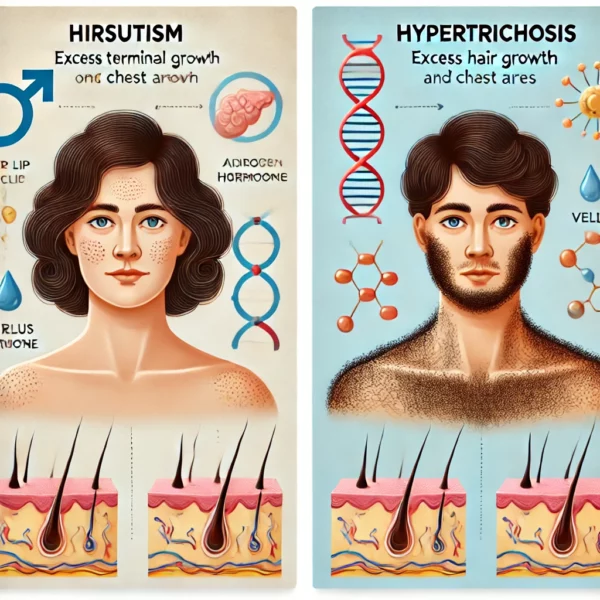
Excess hair growth can be classed as hypertrichosis or hirsutism. The distinction between hypertrichosis and hirsutism is often subtle, particularly when instigated by medication. However, in general, hypertrichosis can be defined as non-androgen-dependent excess hair growth and can involve both vellus and terminal hair. Drug-induced hypertrichosis can occur with a wide range of drugs, though it is dose-dependent and usually reversible following drug withdrawal. In contrast, Hirsutism represents excess terminal hair growth in androgen-sensitive areas (the beard, moustache, and to a lesser extent the chest, arm and leg hair). This comes about commonly due to excessive androgen stimulation as a consequence of certain medical drugs.
Mechanisms of Drug-Induced Excess Hair Growth: Many medications have been identified to induce hypertrichosis or hirsutism, though usually the side effect is fairly rare and only affects a few people of those taking the medical drug. The molecular pathways by which these drugs act on hair follicles are not entirely deciphered and will be different depending on the drug mode of action. Nevertheless, the following biological mechanisms have been recognized as underlying drug induced excess hair growth:
Androgenic Effects: For example, drugs such as testosterone, anabolic steroids, and danazol may exacerbate hirsutism.
Impact on Hair Growth Phase: Certain drugs, the classic example being minoxidil, may prolong the anagen hair growth phase, leading to exceptionally long hair fibers.
Transformation of Hair Type: Some medications can cause fine vellus hairs to grow larger and begin producing pigmented terminal hair.
The list of medications associated with hypertrichosis is extensive. Where excess hair growth is a known side effect, it should be listed on the package insert that comes with the drug. Excess hair growth is a rare event with most drugs. However, there are few drug categories where hair growth as a side effect is more well-known including categories like antibiotics (eg. streptomycin), anti-inflammatory agents (eg. benoxaprofen, corticosteroids), vasodilators (eg. minoxidil, diazoxide, prostaglandin analogues, verapamil), diuretics (eg. acetazolamide), anticonvulsants (eg. phenytoin, valproic acid), immunosuppressants (eg. cyclosporine, mycophenolate mofetil), antiretrovirals (eg. zidovudine) and EGFR inhibitors. A few of the more classic categories of drugs that promote excess hair growth are summarized below:
Minoxidil: Minoxidil therapy is associated with hypertrichosis in 24-100 percent of cases, and increased hair growth can begin as soon as two to three weeks after starting treatment. With minoxidil applied to the scalp, there is still some risk of promoting hair growth elsewhere on the body, this seems to be more likely to occur in women as compared to men. The hair growth, often described as severe and noticeable on the trunk, limbs, and face, is completely reversible after discontinuing the drug. The growth is not androgen-mediated and, while it has been proposed that minoxidil might induce growth by increasing cutaneous blood flow (similar to diazoxide), this mechanism has been questioned due to conflicting results in blood flow measurements. It has been suggested that in utero exposure to medications such as minoxidil can lead to congenital generalised hypertrichosis in new-borns.
Cyclosporine: Cyclosporine is used to control immune responses in people who have received organ transplants. Hypertrichosis is a frequent side effect of cyclosporine therapy, occurring to some degree in 95 percent of cases in one report. It affects various parts of the body including the trunk, back, neck, shoulders, and face, and appears to be more common in children and adolescents than adults. The condition may manifest within the first month and increase over six months, indicating that the effect might be dose-related, although no direct relationship with serum concentrations has been established. The exact mechanism is unknown, but it is not thought to be androgen-mediated. Hypertrichosis due to tacrolimus, another drug used to prevent immune responses in organ transplant patients, is uncommon. In a randomized clinical trial comparing the side effects of tacrolimus and cyclosporine in renal transplant patients, only 0.6% of patients on tacrolimus experienced hypertrichosis, compared to 8.9% of those on cyclosporine.
Corticosteroids: Corticosteroids, even when administered by inhalation, can occasionally cause excessive hair growth. This effect is particularly noted when used at high doses or in conjunction with another corticosteroid administered through a different method. A study reported that this occurred in 11 boys and 12 girls, aged between 1 and 17, who were treated with inhaled corticosteroids, mostly for asthma. Some of these children were also receiving corticosteroids through another route, typically via the skin. The excess hair growth was observed on the back, arms, legs, and occasionally the face, from 1 to 36 months after beginning corticosteroid therapy.
Oral contraceptives: Approximately 0.1 percent of women taking oral contraceptives may experience facial hypertrichosis, more accurately referred to as hirsutism, as it is an androgen-mediated effect. The progestin component in oral contraceptives, derivatives of 19-nortestosterone, including levonorgestrel (found in low doses in many contraceptives), is thought to cause these androgenic and antiestrogenic effects. The potential for an oral contraceptive to cause hirsutism in a susceptible woman depends on several factors, including the specific effects of the progestogen on SHBG (Sex Hormone Binding Globulin) production, its binding affinity to SHBG and androgen receptors, and the estrogenic effects of the contraceptive’s estrogen component.
Androgens: Androgens, including testosterone, have an impact on organs with androgen receptors, including hair follicles. Testosterone, used mainly for male hypogonadism or decreased libido in women, may cause excessive hair growth. Danazol, which is employed for endometriosis, has been identified as a cause of excessive hair growth due to its androgenic effects. DHEA (dehydroepiandrosterone), a precursor of androgens and estrogens, has been used for various conditions including cardiovascular disease, can also lead to excessive hair growth. Tibolone, a synthetic steroid used to alleviate menopausal symptoms, may cause excessive hair growth as a result of its androgenic properties.
Conclusion: Drug-induced excess hair growth, encompassing both hypertrichosis and hirsutism, is a complex phenomenon with multifaceted etiological factors. Understanding the underlying mechanisms remains an area of active exploration, demanding further research to unveil the molecular processes at play. The consequences of drug-induced excess hair growth transcend the physiological domain, deeply rooted in sociocultural and personal perceptions of normality. Patients afflicted with these conditions often experience significant psychosocial distress, underscoring the necessity of careful evaluation and management by medical professionals. Careful physician management, education, and a personalized approach towards therapy are vital to mitigate the adverse effects of these medications.
Miwa LJ, Shaefer MS, Stratta RJ, Wood RP, Langnas AM, Shaw BW. Drug-induced hypertrichosis: case report and review of the literature. DICP. 1990 Apr;24(4):365–8.
1.
de Vries TW, de Langen-Wouterse JJ, de Jong-Van den Berg LTW, Duiverman EJ. Hypertrichosis as a side effect of inhaled steroids in children. Pediatr Pulmonol. 2007 Apr;42(4):370–3.
1.
Choi YM, Diehl J, Levins PC. Promising alternative clinical uses of prostaglandin F2α analogs: beyond the eyelashes. J Am Acad Dermatol. 2015 Apr;72(4):712–6.
Bienenfeld A, Azarchi S, Lo Sicco K, Marchbein S, Shapiro J, Nagler AR. Androgens in women: Androgen-mediated skin disease and patient evaluation. J Am Acad Dermatol. 2019 June;80(6):1497–506.
1.
Antoury L, Cheng M, Cheng CE. Localized hypertrichosis following tacrolimus therapy: A case report and brief review. Dermatol Ther. 2021 Mar;34(2):e14782.
1.
Asfour L, Rutkowski D, Harries M. Drug-Induced Hair Changes. In: Lee HY, Creamer D, editors. Drug Eruptions. Cham: Springer International Publishing; 2022. p. 237–46. (Updates in Clinical Dermatology).
1.
Ando Y, Ono S, Ono Y, Miura Y. Hypertrichosis and topical corticosteroid use. Cleve Clin J Med. 2022 Feb 1;89(2):71–2.
Hair growth is a normal physiological process that varies widely among individuals based on genetic, hormonal, and environmental factors. However, certain conditions can lead to…
Wilgefortis, a figure more of folklore than religion, often surfaces in narratives marked by her distinguishing facial hair, leading to the colloquial moniker ‘The Bearded…
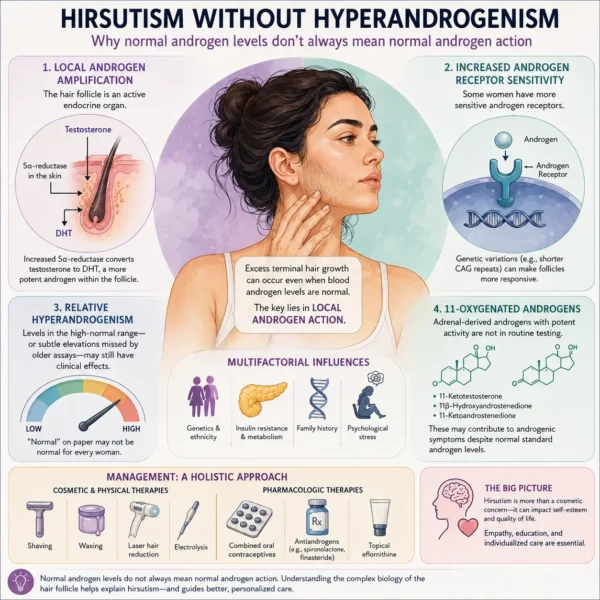
Hirsutism is traditionally viewed as a clinical sign of androgen hormone excess in the body. Excessive terminal hair growth in androgen-dependent areas of the female…
Manage Cookie Consent
We use technologies like cookies to store and/or access device information. We do this to improve browsing experience and to show (non-) personalized ads. Consenting to these technologies will allow us to process data such as browsing behavior or unique IDs on this site. Not consenting or withdrawing consent, may adversely affect certain features and functions.
Functional Always active
The technical storage or access is strictly necessary for the legitimate purpose of enabling the use of a specific service explicitly requested by the subscriber or user, or for the sole purpose of carrying out the transmission of a communication over an electronic communications network.
Preferences
The technical storage or access is necessary for the legitimate purpose of storing preferences that are not requested by the subscriber or user.
Statistics
The technical storage or access that is used exclusively for statistical purposes.The technical storage or access that is used exclusively for anonymous statistical purposes. Without a subpoena, voluntary compliance on the part of your Internet Service Provider, or additional records from a third party, information stored or retrieved for this purpose alone cannot usually be used to identify you.
Marketing
The technical storage or access is required to create user profiles to send advertising, or to track the user on a website or across several websites for similar marketing purposes.