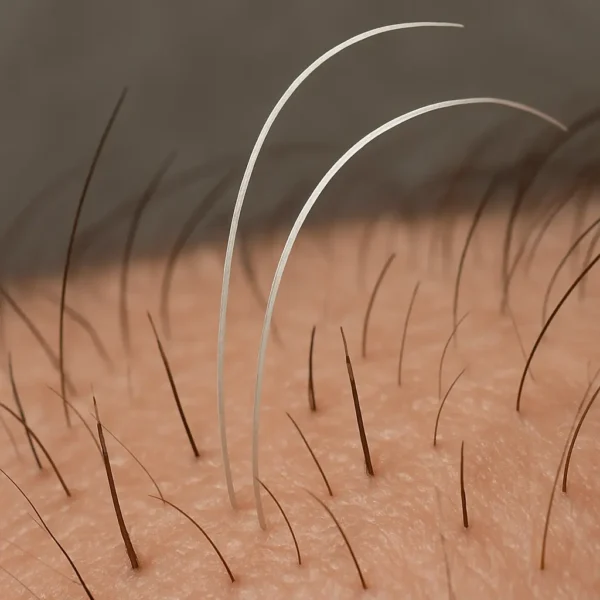
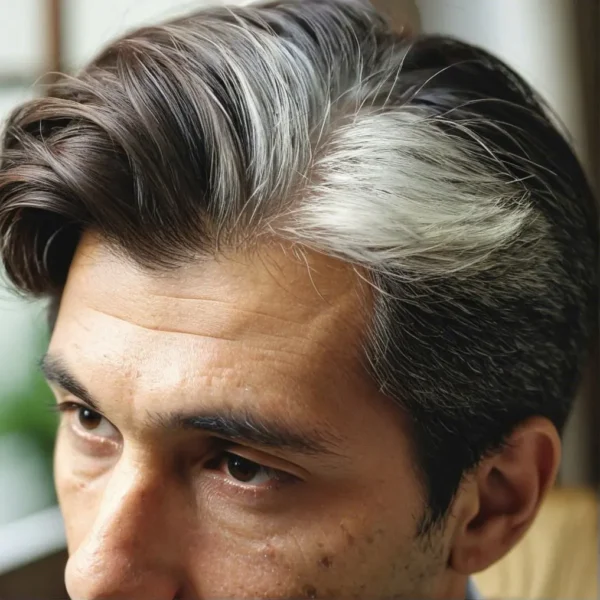
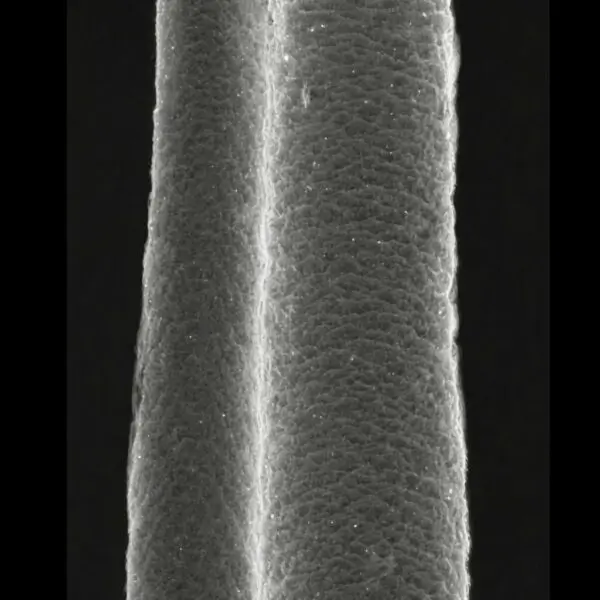
Greying is one of the most visible hallmarks of human ageing, yet its functional consequences for hair fibre biology are often overlooked. Clinicians and lay observers alike note that newly white hair strands can appear coarser and seem to “sprout” more quickly than their pigmented neighbours, raising a deceptively simple question: do non-pigmented hairs truly grow thicker and faster, or is this an artefact of contrast and perception? Addressing this requires separating visibility effects from measurable differences in shaft caliber, medullation, and linear growth rate across scalp regions and body sites, while accounting for age, sex, and alopecia status. This article reviews the – admittedly rather limited – data on white hair and pigmented hair biology to evaluate whether the absence of melanogenesis is associated with altered hair growth dynamics. We also consider plausible mechanisms – metabolic reallocation, anagen-supportive signalling shifts, and keratin/KRTAP program changes – and the practical implications for diagnosis, phototrichogram methodology, and interpretation of clinical trials in mixed-pigmentation scalps.
Scalp hair (women; mixed ages): Van Neste evaluated ~3,300 scalp hairs sampled one month after clipping from three sites (top and occipital) in 24 women (12 menopausal with repeat sampling; 12 non-menopausal controls). Hairs were classified as pigmented (P) or white (W). Across all sites, white hairs had a larger mean diameter (~67.7 μm vs ~57.4 μm) and a more developed medulla (23.9% vs 12.2%). Crucially, linear growth rate was higher in white hairs (0.38 mm/day vs 0.35 mm/day overall), with a site-by-pigmentation interaction: occipital white (0.40 mm/day) > top white (0.37) ≈ occipital pigmented (0.37) > top pigmented (0.34). In paired subsets matched for diameter (50–80 μm), white hairs still grew about 10% faster, arguing the growth-rate difference is not simply a thickness artifact.
Beard hair (men): In a three-year longitudinal series of >100 measurements across three men, Nagl tracked labelled beard hairs and then examined plucked shafts. White beard hairs grew roughly twice as fast as pigmented beard hairs on average (mean ~1.12 mm/day vs ~0.47 mm/day) in anagen. Shaft diameters and medullation did not differ significantly in that beard dataset, suggesting the rate difference can occur without major calibre differences in this body site. Nagl also observed earlier nuclear chromatin condensation (a marker of terminal differentiation) in pigmented vs white hair suprabulbar regions, hypothesizing that less “luxury” work (melanin synthesis and transfer) might permit prolonged proliferation and faster fiber elongation in non-pigmented follicles.
Integrative molecular evidence (scalp): A later study compared microdissected bulbs from human white vs black scalp hairs. White hairs showed up-regulation of multiple keratins and keratin-associated proteins (KRT6, KRT14/16, KRT25; several KRTAP4 isoforms) on microarray, RT-PCR, and immunohistochemistry, consistent with more active keratinization and shaft formation. At the same time, FGF7 (keratinocyte growth factor) was up-regulated and FGF5 (a catagen-promoting factor) down-regulated in white follicles, a signature aligned with prolonged/stronger anagen growth activity. The authors concluded that “hair greying is associated with active hair growth,” nicely dovetailing with the clinical observations of greater length and thickness in white hairs.
Reconciling thickness vs growth rate: A common critique is that thicker hairs often appear to grow “faster” because they are more visible. Van Neste’s paired-diameter analysis addresses this: when white and pigmented hairs are matched for caliber (diameter), white hairs still show a ~10% higher linear growth rate (0.05–0.06 mm/day absolute difference), implying a true kinetic difference rather than a visibility bias. At the same time, site location matters. On the scalp, white hairs were both thicker and faster on average; in the beard, white hairs were faster without a robust thickness difference in that small cohort. Thus, hair thickness/caliber and growth rate can be uncoupled by body region, but white-hair acceleration is a consistent theme.
How might pigment loss accelerate growth: Several non-mutually exclusive mechanisms have been proposed:
Energetic reallocation: Melanogenesis is metabolically costly and tightly coordinated with matrix keratinocyte proliferation. Eliminating pigment synthesis could reduce the metabolic burden and oxidative stress in the bulb, allowing greater proliferative output and/or slower onset of terminal differentiation in the suprabulbar shaft – consistent with Nagl’s nuclear condensation observations.
Shift in growth-factor signalling: The white-hair bulbs showed increased FGF7 (supports anagen/keratinocyte proliferation) and decreased FGF5 (promotes catagen). This pattern is pro-anagen and pro-elongation, offering a molecular explanation for the higher growth rate and sometimes greater length of white hairs (e.g., characteristically long white eyebrow hairs).
Keratin/KRTAP up-regulation and shaft mechanics: Up-regulation of hair keratins and KRTAPs may increase fiber production capacity and alter mechanical properties (stiffness, bending modulus), aligning with reports that non-pigmented fibers are slightly coarser/stiffer than pigmented fibers. While those mechanical studies aren’t the main focus of the studies here, the keratin/KRTAP signal provides a plausible structural correlate.
Melanocyte vulnerability vs follicle resilience: White/grey follicles can accumulate millimolar H₂O₂ and exhibit melanocyte stem-cell failure with age, yet non-pigmented white hair producing follicles maintain robust keratinocyte activity and can outgrow pigmented counterparts in culture and in vivo. This differential sensitivity – melanocytes vs matrix keratinocytes – could leave growth programs intact or even relatively enhanced in the absence of melanogenesis.
Nuances, limitations, and sources of heterogeneity:
Population and sample size: Nagl’s beard series (n=3 men) and Van Neste’s scalp study (n=24 women) are small but carefully controlled (serial labelling for beard; rigorous site-specific sampling for scalp). Conclusions should be viewed as well-founded trends, not immutable laws.
Anatomical site effects: Van Neste reported a site by pigmentation interaction (e.g., occipital white fastest; vertex pigmented slowest), reminding us that regional biology (papilla signalling, follicle density, vascularization) modulates the effect size. The differences in beard vs scalp hair caliber emphasize this point.
Ageing and alopecia context: Van Neste suggests that age- and alopecia-related slowing of growth rate and diameter may be largely confined to pigmented hairs, with white hairs relatively spared. This observation, if generalized, could help explain why greying often co-occurs with apparent “sprouting” of coarser, longer white strands even as overall density declines.
Measurement method sensitivity: Phototrichogram and contrast-dependent imaging, as used in therse studies, can under-detect lightly pigmented hairs, potentially biasing growth-rate reads in drug trials if pigmentation shifts during treatment. Van Neste explicitly flags this methodological pitfall and recommends contrast enhancement for accurate longitudinal assessments in mixed-pigmentation scalps.
Inter-individual variability: Genetics (e.g., FGFR2 variants associated with hair thickness), local microenvironment, endocrine milieu, and hair cycle staging at the time of sampling all contribute to wide variance around the mean. Thus, not every white hair will be thicker or faster than every neighbouring pigmented hair.
Practical implications for clinicians and researchers:
Expect white hairs to bias upwards the mean shaft diameter and growth rate in mixed-pigmentation scalp regions. When quantifying treatment effects or disease progression, stratify by pigmentation where feasible, or apply contrast-standardized imaging.
Do not equate hair greying with follicle senescence/aging in a functional sense. Loss of pigment is not synonymous with loss of proliferative capacity; the opposite signal (more “active” growth) is often observed in white hairs.
Interpret hair-cycle metrics with site-specific context. Vertex versus occiput differences can be as large as pigmentation effects. Incorporate location and pigmentation interactions into analysis plans and power calculations.
Mechanistic studies should consider melanogenesis as a growth-modulating load. Manipulations that alter pigment pathways (e.g., oxidative stress, melanocortin signalling) might secondarily affect growth kinetics via resource allocation or paracrine crosstalk in the bulb.
Conclusions: Across the best available human data, white hairs generally grow faster and (on the scalp) are thicker than pigmented hairs in the same individual. This pattern appears in observational kinetics (beard), morphometrics (scalp), and molecular profiling (scalp bulbs). Mechanistically, the absence of melanogenesis may ease metabolic and differentiation constraints, while pro-anagen signalling (increased FGF7, decreased FGF5) and up-regulated keratin programs support higher output. Regional biology and individual variability modulate the effect, but the answer to the core question is yes, white hairs grow thicker and faster than pigmented hairs in humans.
Nagl W. Different growth rates of pigmented and white hair in the beard: differentiation vs. proliferation? Br J Dermatol. 1995 Jan;132(1):94–7.
1.
Van Neste D, Tobin DJ. Hair cycle and hair pigmentation: dynamic interactions and changes associated with aging. Micron. 2004;35(3):193–200.
1.
Van Neste D. Thickness, medullation and growth rate of female scalp hair are subject to significant variation according to pigmentation and scalp location during ageing. Eur J Dermatol. 2004;14(1):28–32.
1.
Commo S, Gaillard O, Bernard BA. Human hair greying is linked to a specific depletion of hair follicle melanocytes affecting both the bulb and the outer root sheath. Br J Dermatol. 2004 Mar;150(3):435–43.
1.
Trüeb RM. Oxidative stress in ageing of hair. Int J Trichology. 2009 Jan;1(1):6–14.
1.
Yu M, Bell RH, Ho MM, Leung G, Haegert A, Carr N, et al. Deficiency in nucleotide excision repair family gene activity, especially ERCC3, is associated with non-pigmented hair fiber growth. PLoS One. 2012;7(5):e34185.
1.
Jo SK, Lee JY, Lee Y, Kim CD, Lee JH, Lee YH. Three Streams for the Mechanism of Hair Graying. Ann Dermatol. 2018 Aug;30(4):397–401.
Grooved hair, or pili canaliculi, is a rare and unusual condition where hair fibers exhibit longitudinal grooves running along their length. This condition can affect…
Graying hair, medically referred to as canities or achromotrichia, has long been accepted as an inevitable part of the aging process. Coloration of scalp hair…
Manage Cookie Consent
We use technologies like cookies to store and/or access device information. We do this to improve browsing experience and to show (non-) personalized ads. Consenting to these technologies will allow us to process data such as browsing behavior or unique IDs on this site. Not consenting or withdrawing consent, may adversely affect certain features and functions.
Functional Always active
The technical storage or access is strictly necessary for the legitimate purpose of enabling the use of a specific service explicitly requested by the subscriber or user, or for the sole purpose of carrying out the transmission of a communication over an electronic communications network.
Preferences
The technical storage or access is necessary for the legitimate purpose of storing preferences that are not requested by the subscriber or user.
Statistics
The technical storage or access that is used exclusively for statistical purposes.The technical storage or access that is used exclusively for anonymous statistical purposes. Without a subpoena, voluntary compliance on the part of your Internet Service Provider, or additional records from a third party, information stored or retrieved for this purpose alone cannot usually be used to identify you.
Marketing
The technical storage or access is required to create user profiles to send advertising, or to track the user on a website or across several websites for similar marketing purposes.