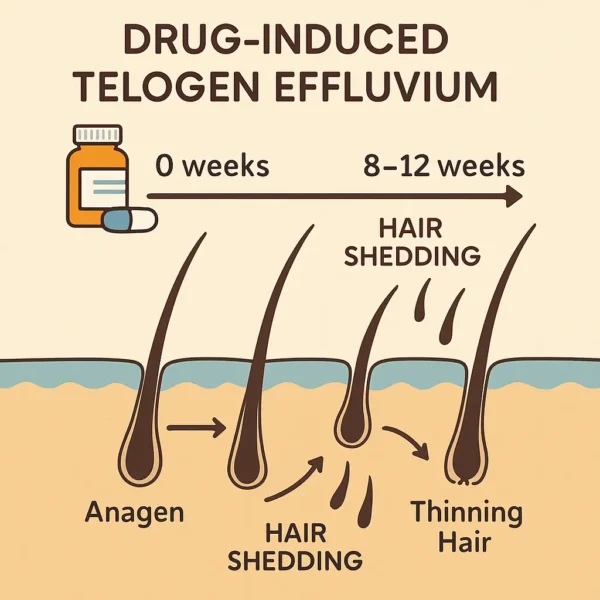
The term “telogen effluvium” was first introduced to the medical lexicon in 1961, despite the symptom it describes – diffuse hair shedding – having been observed and reported throughout the 20th century. Telogen effluvium (TE) is a form of hair loss characterized by its generalized and diffuse nature, typically spanning across the scalp and, in some cases, the body. This condition is unique in its development, often progressing slowly over several months, and distinct in its prognosis, as it is typically a reversible form of hair loss with recovery and return to normal hair density possible but notably slow, often requiring many months.
The etymology of “telogen effluvium” provides a succinct explanation of the condition. The term “telogen” refers to the resting phase of the hair follicle’s cycle, while “effluvium” is a Latin word that translates to “letting loose”. Thus, the term “telogen effluvium” captures the key pathological process of this condition – the entrance of hair follicles into a resting state and the subsequent shedding of the hair fiber.
In a healthy individual, a balance between active hair growth (anagen phase) and dormancy (telogen phase) is maintained, with approximately 90% of hair follicles actively producing hair and 10% in the resting phase at any given time. Telogen effluvium disrupts this equilibrium, leading to an increase in the proportion of hair follicles in the telogen phase. This imbalance results in increased hair shedding and diffuse thinning of scalp and/or body hair. In extremely rare instances, nearly all hair follicles may enter the telogen phase, culminating in almost complete scalp hair loss.
The diagnosis of telogen effluvium is essentially an umbrella term for a myriad of hair loss patterns and a range of causative factors. Regardless of the specific presentation or underlying cause, the diagnosis of TE is applicable if an abnormally large proportion of hair follicles are in the telogen phase. This diagnostic label is not exclusive to isolated hair loss cases; it can also be relevant in other hair loss conditions such as the early stages of androgenetic alopecia.
Various trigger factors can instigate both anagen and telogen effluvium, sometimes within the same individual. This complexity necessitates caution in interpreting the list of known trigger factors for telogen effluvium. Furthermore, it is crucial to remember that the exposure to the trigger factor may have occurred up to four months prior to the onset of noticeable hair loss, making the identification of the causative agent challenging.
A multitude of factors can cause telogen effluvium, ranging from dietary deficiencies, hormonal fluctuations, exposure to certain drugs, and various types of stress. For instance, nutrient deficiencies – particularly iron – can compromise hair follicle health, as can crash dieting which deprives hair follicles of vital nutrients. Hormonal changes, particularly during and after pregnancy, can also precipitate telogen effluvium.
Alopecia induced by fever, acute blood loss, or severe illness can occur as the body’s resources are redirected to manage the disease process, often at the expense of hair follicle activity. Certain medications, as well as excessive intake of vitamin A, can also result in TE. Other potential causes include hyperthyroidism or hypothyroidism, UV radiation exposure, and extreme physical or emotional stress. In newborns, a condition known as neonatal effluvium may lead to diffuse hair loss during the initial months of life.
In conclusion, telogen effluvium is a complex and multifactorial condition. Though much has been learned about TE since its first description in the 1960s, ongoing research continues to elucidate the intricacies of this common hair loss condition. The interplay between various physiological factors, as well as the role of external stressors, forms a complex web that we are still untangling. While the diagnosis and management of TE remain challenging, advances in understanding the biology of hair follicles and their response to internal and external stressors are paving the way for improved diagnostic methods and therapeutic interventions.
Ultimately, the journey towards unravelling the complexities of TE mirrors the broader endeavor of scientific discovery. Each new finding builds upon the foundation laid by previous research, bringing us closer to a future where hair loss disorders like TE can be effectively diagnosed, managed, and potentially even prevented. While we may not have all the answers yet, the progress made thus far offers hope for those affected by this condition and underscores the importance of continued research in this field.
Vaccinations have long been recognized as essential public health tools that reduce the burden of infectious diseases worldwide. With the rapid development and widespread administration…
Understanding Telogen Effluvium: Telogen effluvium (TE) is a nonscarring, reversible form of diffuse hair loss characterized by an increased proportion of hair follicles entering the…
Manage Cookie Consent
We use technologies like cookies to store and/or access device information. We do this to improve browsing experience and to show (non-) personalized ads. Consenting to these technologies will allow us to process data such as browsing behavior or unique IDs on this site. Not consenting or withdrawing consent, may adversely affect certain features and functions.
Functional Always active
The technical storage or access is strictly necessary for the legitimate purpose of enabling the use of a specific service explicitly requested by the subscriber or user, or for the sole purpose of carrying out the transmission of a communication over an electronic communications network.
Preferences
The technical storage or access is necessary for the legitimate purpose of storing preferences that are not requested by the subscriber or user.
Statistics
The technical storage or access that is used exclusively for statistical purposes.The technical storage or access that is used exclusively for anonymous statistical purposes. Without a subpoena, voluntary compliance on the part of your Internet Service Provider, or additional records from a third party, information stored or retrieved for this purpose alone cannot usually be used to identify you.
Marketing
The technical storage or access is required to create user profiles to send advertising, or to track the user on a website or across several websites for similar marketing purposes.