A recent study has prompted the intriguing suggestion that hair graying may be more than a passive sign of aging. It may, in some circumstances, represent a protective mechanism against the risk of developing melanoma. Several news items have recently been published in popular science magazines and some newspapers making this claim. The idea is attractive because it links two familiar age-associated phenomena, gray hair and cancer, through a shared cellular origin: the melanocyte cell lineage. However, the hypothesis needs careful interpretation. The research that was done does not directly show that gray hair itself protects the body from melanoma development risk in the everyday sense. Rather, it shows that certain damaged pigment stem cells in mouse hair follicles can be forced into a terminal, non-renewing fate that removes them from the pool of cells capable of founding melanoma. That is a very different claim.
The biological background: Hair color depends on melanocytes, the pigment-producing cells that synthesize melanin and transfer it into the growing hair shaft. These melanocytes are replenished during successive hair cycles by melanocyte stem cells, or McSCs, located in the hair follicle bulge and sub-bulge region. When these stem cells are lost, mislocalized, or unable to generate functional pigment cells, the follicle produces a gray or white hair.
Melanoma also arises from the melanocyte cell lineage. This makes melanocyte stem cells biologically interesting because they sit at a crossroads between healthy tissue maintenance and cancer risk. A long-lived stem cell that continues to divide despite DNA damage has the theoretical potential to accumulate mutations and seed a malignant cancer cell clone. Conversely, a damaged stem cell that is eliminated can no longer contribute either to pigmentation or to cancer.
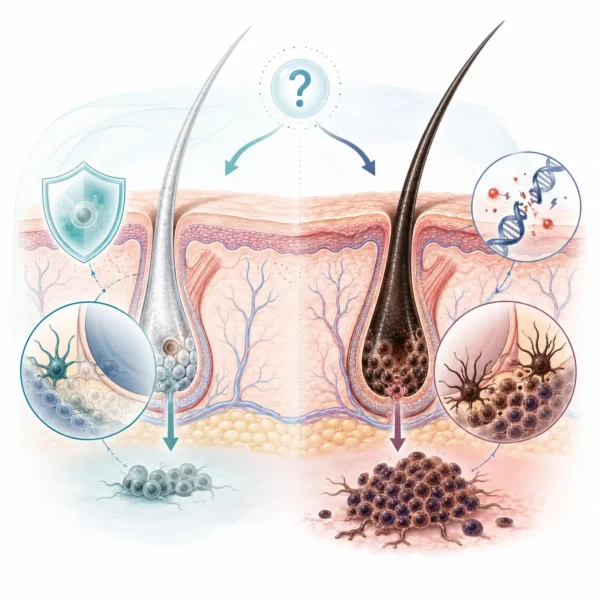
The new research, published in Nature Cell Biology, explored this trade-off in mice. The authors tracked melanocyte stem cell fate after different kinds of genotoxic stress. They reported that DNA double-strand breaks, especially after ionizing radiation, pushed McSCs into a state they called “senescence-coupled differentiation,” or “seno-differentiation.” These cells became cell-cycle arrested, differentiated, and were eventually lost from the follicle niche, leading to hair graying. In this experimental context, depletion of damaged McSCs reduced their ability to serve as melanoma founder cells.
The protective hypothesis: The protective hypothesis can be stated simply; hair graying may reflect the removal of damaged melanocyte stem cells before they become cancerous. In this model, the follicle sacrifices pigmentation to preserve tissue safety. A pigmented hair requires continued McSC self-renewal. If a stem cell has sustained dangerous DNA damage, continued self-renewal could propagate mutations. Forcing that cell to differentiate, arrest, and disappear may be safer, even though the visible consequence is a gray hair.
This logic fits a broader principle in aging biology. Many tissues possess tumor-suppressive checkpoints that limit proliferation after damage. Cellular senescence, apoptosis, terminal differentiation, and stem cell exhaustion can all reduce the risk that damaged and cancerous cells continue dividing. The cost is tissue aging. Skin becomes thinner, regenerative capacity declines, and hair loses pigment. From this perspective, some aging phenotypes can be interpreted as the price paid for cancer suppression.
The mouse study provides mechanistic support for this idea. Ionizing radiation induced DNA damage responses in McSCs, involving p53 and p21 signaling. Deleting p53 in McSCs rescued hair pigmentation after irradiation, implying that the p53 pathway was central to McSC depletion and hair graying – at least in this mouse model. The researchers also found that prior depletion of these stem cells suppressed melanoma development in a genetically engineered mouse melanoma model.
The news articles that talk about the study translated these observations into a more public-facing claim: gray hair may have evolved as a protection against cancer. It describes the same core idea, namely that damaged pigment stem cells can either stop dividing and contribute to graying, or continue replicating and increase tumor risk.
Why the hypothesis is biologically interesting: The most valuable aspect of the hypothesis is not that gray hair is beneficial, but that melanocyte stem cell fate may be antagonistic. The same stem cell population can apparently move toward two opposite outcomes. One outcome is exhaustion; the melanocyte cell leaves the stem cell compartment, pigmentation is lost, and cancer-forming potential is reduced. The other outcome is expansion; the cell self-renews, migrates, or persists in an altered niche, which may preserve pigment but increase cancer risk.
This is a sophisticated model of aging and cancer. It argues against the simplistic view that aging and cancer are completely separate processes. Instead, they may sometimes represent divergent outcomes of how stem cells respond to stress. A tissue may age because it eliminates risky cells. A cancer may arise because a cell escapes that elimination mechanism.
The study also highlights the importance of the follicle niche. Carcinogenic stresses such as DMBA and ultraviolet B light did not simply produce the same outcome as ionizing radiation. Instead, they activated pathways involving arachidonic acid metabolism and niche-derived KIT ligand, which supports McSC maintenance and expansion. In other words, the surrounding epithelial environment of the hair follicle helped decide whether damaged melanocyte-lineage cells were depleted or preserved.
Why the broad claim is unlikely: Despite its elegance, the statement “gray hair protects against melanoma” is too broad. First, the research is mostly from a mouse study. Mouse dorsal hair follicles are not the same as human scalp follicles, and neither exactly reproduces the full ecology of human melanoma. Human melanoma commonly arises on intermittently sun-exposed skin, chronically sun-damaged skin, acral sites, mucosal sites, and from pre-existing nevi. It is not a disease of graying scalp follicles.
Second, the study does not show that people with gray hair have a lower melanoma risk. That epidemiological claim would require human population data controlling for age, skin phototype, UV exposure, nevus burden, ancestry, hair color, genetics, immunosuppression, and surveillance behavior. In real life, melanoma risk rises with age, precisely when graying becomes more common. That does not disprove a local follicular protective mechanism, but it strongly argues against gray hair being a dominant whole-body melanoma defense.
Third, the most melanoma-relevant environmental carcinogen is ultraviolet light radiation. In the mouse study, UVB and DMBA behaved as carcinogenic stresses that could bypass the graying-associated depletion pathway. This is crucial. The result was not simply “damage causes gray hair and prevents cancer.” The result was more conditional: certain cytotoxic DNA double-strand break stresses depleted McSCs, while carcinogenic stresses could preserve or expand them through niche signals. If UV light exposure can support the competing cancer-promoting pathway, then ordinary sun-induced melanoma risk is unlikely to be solved by hair graying.
Fourth, gray hair does not protect the skin in the same way that skin melanin does. Hair shaft pigmentation may influence light absorption in hair follicles, but melanoma usually develops in skin melanocytes, not in the dead hair fiber or hair follicle bulbs. Loss of hair pigment is not equivalent to improved UV defense. If anything, melanin is generally photoprotective. A white or gray hair shaft may reflect more light, but this is not a convincing biological explanation for melanoma prevention across the body.
Fifth, any evolutionary claims require special caution. For a trait to evolve primarily as cancer protection, it should improve reproductive fitness. Most age-associated graying occurs after the main reproductive years, when natural selection is weaker. Premature graying exists, but it is highly variable and not obviously tied to lower melanoma incidence. A more conservative interpretation is that graying is a consequence of conserved tumor-suppressive stress responses, not a trait selected specifically to prevent melanoma.
A better interpretation of the data: The strongest interpretation is local and mechanistic: under some forms of severe DNA damage, melanocyte stem cells may be removed from the hair follicle by a p53-linked senescence and differentiation program. This causes graying and may reduce the chance that those particular damaged cells later contribute to melanoma. That is plausible and important.
The weaker interpretation is global and evolutionary: humans gray because graying evolved to protect us from melanoma. That is not established and is probably unlikely. Human graying has multiple causes, including age-related McSC depletion, oxidative stress, genetic variation, follicle cycling changes, autoimmune disease, nutritional factors, and rare syndromic disorders. Melanoma risk is also multifactorial and strongly influenced by sun light / UV light exposure, skin type, nevus biology, DNA repair capacity, immune surveillance, and somatic gene mutations.
Conclusion: Hair graying may sometimes be the visible footprint of a useful cellular safeguard. A follicle that loses pigment may have eliminated damaged melanocyte stem cells that would otherwise remain capable of proliferation. In that limited sense, hair graying can be viewed as a tumor-suppressive consequence of stem cell exhaustion. But it is misleading to say that gray hair, as a visible trait, protects people from melanoma. The new study reveals an elegant antagonism between melanocyte stem cell depletion and melanocyte-lineage cancer formation in mice. It does not prove that human hair graying is an evolved anti-melanoma adaptation. Importantly, the research study does not mean people with gray hair are protected from melanoma cancer or that having dark hair increases the risk of melanoma development. There is no evidence for these claims.
Nishimura EK, Jordan SA, Oshima H, Yoshida H, Osawa M, Moriyama M, et al. Dominant role of the niche in melanocyte stem-cell fate determination. Nature. 2002 Apr 25;416(6883):854–60.
1.
Sarin KY, Artandi SE. Aging, graying and loss of melanocyte stem cells. Stem Cell Rev. 2007;3(3):212–7.
1.
Seiberg M. Age-induced hair greying - the multiple effects of oxidative stress. Int J Cosmet Sci. 2013 Dec;35(6):532–8.
1.
Sun Q, Lee W, Hu H, Ogawa T, De Leon S, Katehis I, et al. Dedifferentiation maintains melanocyte stem cells in a dynamic niche. Nature. 2023 Apr;616(7958):774–82.
1.
Mohri Y, Nie J, Morinaga H, Kato T, Aoto T, Yamanashi T, et al. Antagonistic stem cell fates under stress govern decisions between hair greying and melanoma. Nat Cell Biol. 2025 Oct;27(10):1647–59.
1.
TOKYO TIOMS THE UNIVERSITY OF. Graying Hair May Reflect a Natural Defense Against Cancer Risk, New Study Finds. 2025 Oct 20;
1.
The Institute of Medical Science TU of T. Scientists just found a surprising link between gray hair and cancer. ScienceDaily. 2025 Oct 25;
1.
The University of Tokyo TI of MS. Gray Hair May Be Your Body’s Secret Cancer Defense. SciTechDaily. 2025.
Structure of Beard Hair: The structure of male beard hair is intriguingly complex and markedly different from scalp hair. The variability in shape encompasses various…
The article titled “Signalling by senescent melanocytes hyperactivates hair growth” in the journal Nature is a research study that investigates the role of senescent melanocytes…
Manage Cookie Consent
We use technologies like cookies to store and/or access device information. We do this to improve browsing experience and to show (non-) personalized ads. Consenting to these technologies will allow us to process data such as browsing behavior or unique IDs on this site. Not consenting or withdrawing consent, may adversely affect certain features and functions.
Functional Always active
The technical storage or access is strictly necessary for the legitimate purpose of enabling the use of a specific service explicitly requested by the subscriber or user, or for the sole purpose of carrying out the transmission of a communication over an electronic communications network.
Preferences
The technical storage or access is necessary for the legitimate purpose of storing preferences that are not requested by the subscriber or user.
Statistics
The technical storage or access that is used exclusively for statistical purposes.The technical storage or access that is used exclusively for anonymous statistical purposes. Without a subpoena, voluntary compliance on the part of your Internet Service Provider, or additional records from a third party, information stored or retrieved for this purpose alone cannot usually be used to identify you.
Marketing
The technical storage or access is required to create user profiles to send advertising, or to track the user on a website or across several websites for similar marketing purposes.