Although dramatic cases are uncommon, trichobezoars are a recognized clinical entity in gastroenterology and psychiatry. They sit at the intersection of hair biology, behavioral health, and gastrointestinal pathology. For a website devoted to the many dimensions of hair, trichobezoars represent a striking example of how hair’s unique biochemical properties can create unexpected consequences inside the human body.
What Is a Bezoar: A bezoar is a compact mass of indigestible material that accumulates in the gastrointestinal tract, most often in the stomach. The term derives from the Persian word padzahr, meaning antidote, reflecting a historical belief that bezoars had medicinal properties.
Bezoars are classified according to their composition:
Phytobezoars: composed of indigestible plant fibers such as cellulose, hemicellulose, and lignin.
Trichobezoars: composed of hair.
Pharmacobezoars: formed from medications that do not dissolve properly.
Mycotic bezoars: rare masses composed of fungal organisms.
Among these, trichobezoars are particularly distinctive because they are formed from a uniquely resilient biological fiber: human hair.
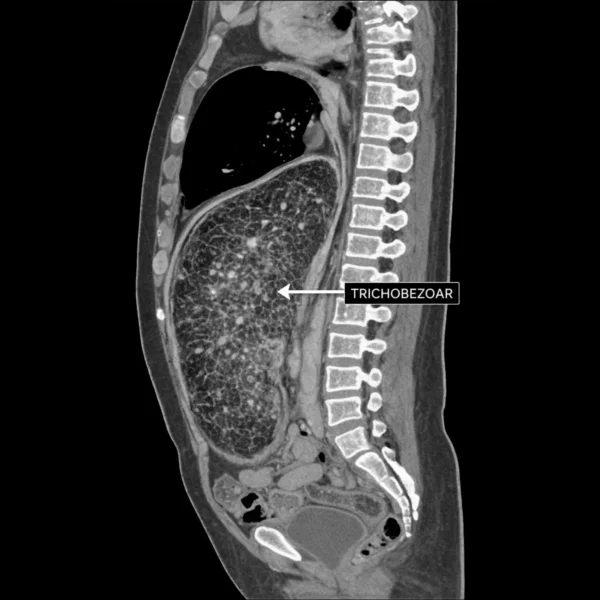
What Is a Trichobezoar: A trichobezoar is a mass of swallowed hair that accumulates in the stomach and occasionally extends into the small intestine. It develops in individuals who repeatedly ingest hair, a behavior known as trichophagia.
Trichophagia is frequently associated with Trichotillomania, a psychiatric condition characterized by recurrent, compulsive hair pulling. Not all individuals with trichotillomania ingest hair, but a subset do. Over time, swallowed strands become entangled, compacted, and matted together within the stomach.
Because hair is smooth and slippery, it resists propulsion by normal gastric peristalsis. Instead of passing through the digestive tract, strands accumulate in the gastric folds. With continued ingestion, the mass enlarges gradually, sometimes over years.
Why Hair Is Indigestible: Hair’s indigestibility is rooted in its structure. The hair shaft is composed primarily of keratin, a highly cross-linked structural protein rich in cysteine residues that form disulfide bonds. These bonds provide extraordinary tensile strength and chemical stability. While stomach acid (hydrochloric acid) is highly corrosive to many biological materials, it does not effectively break down keratinized hair.
Interestingly, hair within a trichobezoar almost always appears black, regardless of its original color. This occurs because:
Gastric acid denatures hair proteins.
Pigments are altered chemically.
The dense, compacted mass becomes coated with oxidized material and food debris.
Over time, the bezoar may trap undigested fat, mucus, and bacteria. When removed surgically, trichobezoars often have a characteristic foul odor due to bacterial colonization and decomposing organic material within the hair matrix.
Who Develops Trichobezoars: Although rare overall, certain demographic patterns are well established:
Approximately 80–90% of reported cases occur in females.
Many patients are adolescents or young adults.
A substantial proportion have underlying psychiatric or behavioral disorders.
In a review of over 100 collected cases, the most common symptoms included:
Palpable abdominal mass (approximately 85–90%)
Abdominal pain (around 70%)
Nausea and vomiting (about 60–65%)
Weight loss and weakness (about 35–40%)
Altered bowel habits
Occasional hematemesis (vomiting blood)
However, presentation varies widely depending on the size and location of the mass.
The “Rapunzel Syndrome”: In particularly severe cases, the hair mass extends beyond the stomach into the small intestine. This dramatic presentation is known as Rapunzel syndrome.
The name references the fairy-tale character Rapunzel, whose long hair extended from a tower. In medical terms, the “tail” of the bezoar can extend deep into the jejunum or even further.
Rapunzel syndrome can cause:
Gastric outlet obstruction
Small bowel obstruction
Intestinal perforation
Pancreatitis
Severe malnutrition
Although rare, such cases can be life-threatening.
How Do Trichobezoars Cause Harm: A trichobezoar grows slowly. Many patients remain asymptomatic for years. Symptoms typically arise once the mass becomes large enough to interfere with normal gastric function.
Mechanical Obstruction: The bezoar may block the pylorus (the outlet of the stomach), preventing food from passing into the small intestine. This leads to vomiting, abdominal distension, and dehydration.
Ulceration and Bleeding: As the mass presses against the stomach wall, it can cause chronic irritation. The gastric mucosa may ulcerate, leading to bleeding. In severe cases, hemorrhage can be catastrophic.
Perforation: Prolonged pressure or ulceration can result in full-thickness perforation of the stomach or intestine, allowing gastric contents to spill into the abdominal cavity. This causes peritonitis, a surgical emergency.
Malnutrition: Large trichobezoars reduce stomach capacity and impair digestion, leading to early satiety and weight loss.
Diagnosis: Diagnosis often begins with clinical suspicion. A patient may present with:
Chronic abdominal pain
Unexplained weight loss
A palpable abdominal mass
Iron-deficiency anemia
Imaging plays a key role:
Ultrasound may show a hyperechoic intragastric mass with acoustic shadowing.
CT scanning provides detailed visualization of a well-defined intraluminal mass with trapped air.
Upper endoscopy confirms the diagnosis by direct visualization.
Endoscopy also allows assessment of mucosal damage and sometimes small-bezoar removal.
Treatment: Management depends on size and complications.
Endoscopic Removal: Small trichobezoars may be fragmented and removed via endoscopy. However, hair’s fibrous toughness makes fragmentation difficult. Endoscopic tools are often inadequate for large, densely matted masses.
Surgical Removal: Large trichobezoars usually require surgical gastrotomy. Traditionally, this involved open abdominal surgery. Increasingly, laparoscopic approaches are used in selected cases.
Surgery carries risks, including bleeding and infection. Historically, gastric operations carried significant mortality, particularly before advances in anesthesia, antibiotics, and perioperative care.
In modern practice, mortality from elective gastric surgery is far lower than historical estimates, but emergency operations for complications such as perforation still carry risk.
The Psychiatric Dimension: Treating the gastrointestinal complication alone is insufficient. Without addressing the underlying behavioral disorder, recurrence is possible.
Trichophagia often coexists with:
Anxiety disorders
Obsessive-compulsive spectrum disorders
Depression
Trauma-related conditions
Management may include:
Cognitive behavioral therapy
Habit reversal training
Selective serotonin reuptake inhibitors in selected cases
Psychiatric evaluation is therefore an essential component of comprehensive care.
Why Don’t Most People Who Swallow Hair Develop Trichobezoars: Accidental ingestion of small amounts of hair is common and usually harmless. The difference lies in:
Volume and frequency of ingestion
Gastric motility patterns
Individual behavioral persistence
Possibly subtle variations in digestive physiology
Repeated ingestion over months or years allows accumulation beyond the stomach’s capacity to clear the strands.
Hair Biology Meets Gastroenterology: From a biological standpoint, trichobezoars illustrate the extraordinary durability of keratinized structures.
Hair is:
Resistant to enzymatic digestion
Chemically stable in acidic environments
Mechanically cohesive when entangled
The same properties that make hair useful for cosmetic styling and protective insulation make it problematic inside the digestive tract. In effect, the stomach becomes an unintended containment chamber for a gradually expanding keratin mass.
Prevention and Awareness: Early intervention in trichotillomania and trichophagia is the most effective preventive strategy.
Warning signs may include:
Noticeable hair thinning with broken shafts
Habitual hair chewing
Gastrointestinal complaints in a person known to ingest hair
Parents, teachers, and clinicians should be aware that persistent hair ingestion is not merely a harmless habit. While most cases do not progress to trichobezoar formation, chronic ingestion carries genuine risk.
A Rare but Important Condition: Trichobezoars are uncommon, and fatal cases are rarer still. Nevertheless, they serve as a powerful reminder that hair, though biologically inert once keratinized, can have significant medical consequences under unusual circumstances.
For those interested in hair from a biological perspective, trichobezoars represent an unusual but revealing phenomenon: a demonstration of hair’s chemical resilience, mechanical cohesion, and capacity to persist even within one of the body’s most hostile environments.
Hair is remarkably durable. In most contexts, that durability is harmless or even advantageous. In rare instances, however, it can become the core of a potentially dangerous condition.
Understanding trichobezoars requires appreciation not only of gastrointestinal pathology but also of hair biology and human behavior. It is precisely at this intersection that medicine often reveals its most unexpected stories.
Nour I, Abd Alatef M, Megahed A, Yahia S, Wahba Y, Shabaan AE. Rapunzel syndrome (gastric trichobezoar), a rare presentation with generalised oedema: case report and review of the literature. Paediatr Int Child Health. 2019 Feb;39(1):76–8.
1.
Niţă AF, Hill CJ, Lindley RM, Marven SS, Thomson MA. Human and Doll’s Hair in a Gastric Trichobezoar, Endoscopic Retrieval Hazards. J Pediatr Gastroenterol Nutr. 2020 Aug;71(2):163–70.
1.
Snorrason I, Ricketts EJ, Stein AT, Thamrin H, Lee SJ, Goldberg H, et al. Sex Differences in Age at Onset and Presentation of Trichotillomania and Trichobezoar: A 120-Year Systematic Review of Cases. Child Psychiatry Hum Dev. 2022 Feb;53(1):165–71.
1.
Schuler L, Hodel M, Stieger C. The Rapunzel syndrome: a hairy tale. Surg Case Rep. 2023 Mar 28;9(1):49.
1.
Kwon HJ, Park J. Treatment of large gastric trichobezoar in children: Two case reports and literature review. Medicine (Baltimore). 2023 Apr 21;102(16):e33589.
1.
Bourabaa S, Pastorino L, Fadel P, Heyd B. Huge gastric trichobezoar causing intestinal obstruction in an adolescent girl: a case report and review of the literature. Ann Med Surg (Lond). 2026 Jan;88(1):896–901.
1.
Scott H, Sansguiri A, Polachek A, Matthews S, Mehta M. Rapunzel syndrome: Trichobezoar-induced pancreatitis unraveled. JPGN Rep. 2026 Feb;7(1):147–9.
Hair color is determined by a complex interplay of genetic, environmental, and physiological factors. Although genetics primarily dictate natural hair color, emerging evidence suggests that…
Introduction: Hair, in its many forms – whether termed fur, wool, or simply hair – is a fundamental aspect of mammalian biology. It represents a…
Manage Cookie Consent
We use technologies like cookies to store and/or access device information. We do this to improve browsing experience and to show (non-) personalized ads. Consenting to these technologies will allow us to process data such as browsing behavior or unique IDs on this site. Not consenting or withdrawing consent, may adversely affect certain features and functions.
Functional Always active
The technical storage or access is strictly necessary for the legitimate purpose of enabling the use of a specific service explicitly requested by the subscriber or user, or for the sole purpose of carrying out the transmission of a communication over an electronic communications network.
Preferences
The technical storage or access is necessary for the legitimate purpose of storing preferences that are not requested by the subscriber or user.
Statistics
The technical storage or access that is used exclusively for statistical purposes.The technical storage or access that is used exclusively for anonymous statistical purposes. Without a subpoena, voluntary compliance on the part of your Internet Service Provider, or additional records from a third party, information stored or retrieved for this purpose alone cannot usually be used to identify you.
Marketing
The technical storage or access is required to create user profiles to send advertising, or to track the user on a website or across several websites for similar marketing purposes.