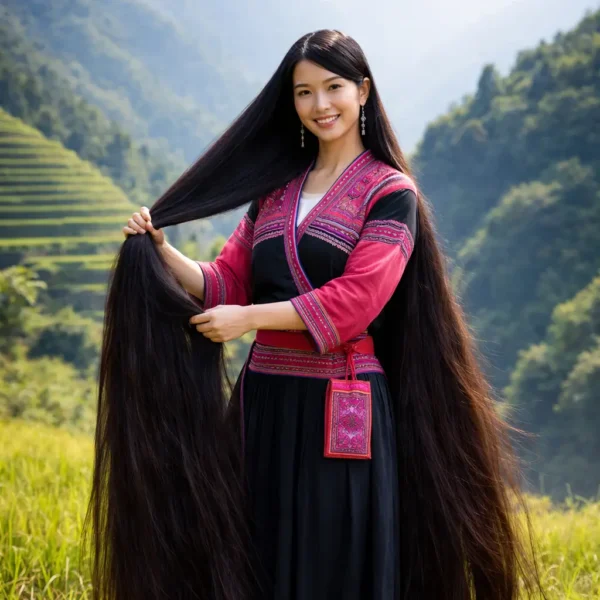
In southern China’s Guangxi Zhuang Autonomous Region, nested among the terraced rice fields and emerald mountains of Longsheng County, lies a village that has drawn curiosity and admiration from around the world. Huangluo Yao Village, often dubbed the “Long Hair Village,” is home to women of the Red Yao ethnic minority who have historically grown their hair to incredible lengths – often to their waists and beyond, sometimes almost as tall as they are.
For centuries, the hair of these women has been far more than a physical trait; it is a vital cultural emblem – woven into rites of passage, identity, cosmology, and community life. This article explores the deep significance of long hair among Yao women, the rituals that surround it, and how these traditions intersect with modernity in the 21st century.
A Symbol of Identity, Health, and Longevity: For the Red Yao people of Huangluo, long hair is a living symbol of life force, vitality, and good fortune. In local belief, a woman’s hair represents her spiritual strength and carries her personal and familial blessings. The longer and healthier a woman’s hair grows, the more it reflects her prosperity, patience, and harmony with the rhythms of nature.
Across generations, women in this community begin growing their hair from birth, nurturing it throughout childhood and adulthood. On average, adult women’s hair often exceeds 1.5 meters (nearly 5 feet) in length, and some have been documented with hair still longer. The ability to grow hair very long is largely a genetic trait, passed down through the generations. The hair-growing tradition dates back to at least the Song dynasty about 1,000 years ago, when people believed long hair symbolized longevity and prosperity.
Rather than viewing hair merely as decoration, Yao culture treats it as an extension of the self – a tangible manifestation of inner health and spiritual balance. This holistic view of hair aligns with traditional East Asian ideas that physical appearance and the unseen life force are intimately connected, an ethos that has sustained these practices for centuries.
A Ritual of Maturity: The One-Time Haircut: Perhaps the most striking of the Yao traditions is the ritualistic haircut that marks a girl’s transition to adulthood. Traditionally, a Red Yao girl’s hair is only cut twice in her lifetime. The firs hair cut is usually about 100 days after birth. The belief is that this hair cut helps hair to grow longer and stronger – though there is no actual scientific evidence for this.
The main hair cutting event comes close to her 18th birthday. This event is not a casual trim: it is a socially significant ritual embedded with meaning. In the past, the haircut – performed by an elder woman, often a grandmother – was accompanied by family celebration and song. The cut hair is not discarded; instead, it is carefully saved and later woven into a decorative headdress by the family, symbolizing continuity between the girl’s past and her future.
In the cosmology of the Red Yao, this haircut signifies the end of childhood, the maturation of spirit, and readiness for the responsibilities of adulthood. In earlier times, no outsider was permitted to witness the haircut, reflecting its sacred nature and the belief that premature cutting could shorten life or invite misfortune.
Communicating Life Stages Through Hairstyle: After the cut, hairstyles among Red Yao women convey nuanced information about a woman’s life stage and marital status.
Unmarried women traditionally cover their long hair completely with a scarf; social norms dictated that an unmarried woman’s hair should not be seen by outsiders.
Married women without children might wear their hair wrapped around the head in two braids – a visible testimony to their marital status.
Married women with children may wrap their hair into more complex bun arrangements, symbolizing motherhood and family continuity.
These coded traditions function as a non-verbal language embedded in everyday life – hair as narrative, telling others who the woman is without a word spoken.
Care, Ritual, and Ancient Practice: Maintaining such extraordinary hair length is a daily practice, not an occasional effort. For generations, Red Yao women have relied on traditional hair-care methods rooted in their agrarian environment.
Central to this routine is the use of fermented rice water, derived from the leftover water used to wash or soak rice – a staple crop of the region. The water, rich in amino acids and antioxidants, is believed to strengthen hair, enhance shine, and keep it healthy without chemical shampoos.
While modern science has begun to analyze fermented rice water’s benefits – identifying compounds that may reduce breakage and improve elasticity – the Yao practice predates such research by generations. For the women of Huangluo, applying rice water and combing their hair daily are ritual acts that bind their physical well-being to the heritage of their ancestors.
From Sacred Secrecy to Global Stage: Historically, outsiders rarely observed the long-hair traditions of the Red Yao. The village remained remote, its customs private and bound within the community. That changed dramatically in the late 20th century with the building of a road to the village in the 1980s and the subsequent advent of tourism in the area.
In 2002, Huangluo Village was recognized by Guinness World Records as the “world’s longest hair village,” a distinction that has amplified global attention.
Today, cultural tourism has transformed the village into a destination for visitors seeking to witness this unique tradition first-hand. Daily performances offer glimpses into hair-combing routines, local song and dance, and other elements of Yao life that had previously been hidden from outsiders.
Tourism has brought both economic opportunity and cultural tension. For a community once isolated, it delivers income that helps sustain livelihoods and encourages younger people to stay connected to their homeland rather than migrating to cities. Yet it also raises questions about preserving authenticity in the face of commodification. Elders and cultural custodians work to ensure that the traditions remain rooted in meaning rather than staged spectacle.
Hair as Cultural Memory and Resilience: What makes the tradition of long hair in Huangluo more than a tourist curiosity is its role as cultural memory – a lens into how a community understands itself and its place in the world. Over centuries, these customs have woven together belief, environment, identity, and social structure.
Hair, in this context, is not an aesthetic choice alone; it is a saga of continuity:
Continuity with ancestors, as seen in the preservation and weaving of cut hair;
Continuity with nature, through daily hair care drawn from rice-based practices;
Continuity between generations, through closely held rituals and communal narratives.
Even as some modern conveniences – shampoos, electric combs, urban dress – have encroached, many Red Yao women consciously return to ancestral customs. The traditions that make this village distinct are not relics in a museum, but living, adaptive practices.
Modern Reflections and Cultural Dialogue: The story of Huangluo’s long-haired women resonates far beyond Guangxi. It prompts wider reflection on how communities preserve intangible cultural heritage in a rapidly globalizing world. The Yao traditions remind us that beauty disciplines can be more than consumer-driven rituals; they can be embodiments of cultural coherence and intergenerational wisdom.
Academics, beauty practitioners, and sustainability advocates have looked to the Yao practices for inspiration – from fermented rice water formulations to discussions about natural hair care that eschews industrial chemicals.
Yet the value of these traditions lies not merely in their utility – but in their rootedness in a cultural worldview where hair is revered, cared for with intention, and symbolic of life’s deeper meanings.
Conclusion – A Hair Tradition That Tells a Story: In the remote mountains of Guangxi, the long hair of Yao women is more than an impressive physical trait. It is a cultural text – written across generations, preserved through ritual, and lived daily. From the sacred one-time haircut marking adulthood to the everyday washing and combing routines that bind women to their community and environment, hair serves as an enduring symbol of identity, resilience, and spiritual continuity.
For visitors who come to witness the long locks of Huangluo, it is easy to focus on the outward spectacle. But the deeper story is not about length alone; it is about how a community shapes meaning around a deeply personal and intimate aspect of the human body, infusing it with cultural and spiritual resonance that has endured for centuries.
Inamasu S, Ikuyama R, Fujisaki Y, Sugimoto K ‐I. The effect of rinse water obtained from the washing of rice (YU‐SU‐RU) as a hair treatment. Intern J of Cosmetic Sci. 2010;32(5):392–3.
1.
Zhang J. [Local Knowledge and the Transformation of Red Yao Women’s Livelihoods in the Context of Ethnic Tourism: A Case Study of Huangluo Yao Village, Longsheng County, Guangxi]. Tourism Tribune. 2011;26(8):72–9.
1.
Chio JT. A Landscape of Travel: The Work of Tourism in Rural Ethnic China. University of Washington Press; 2014. (Studies on Ethnic Groups in China).
1.
Wang Z, Graburn N. Tourism and Cultural Landscapes in Southern China’s Highlands: Peer-reviewed article. viatourism. 2020 Oct 20;(17).
In the realm of surgical procedures, the practice of preoperative shaving has been a long-standing tradition, often considered a preparatory standard. However, recent studies and…
When men stop shaving, others start talking. Across the past two centuries journalists, preachers, physicians, and social-media influencers, have treated facial hair as a barometer…
Introduction: Hair, an integral part of human identity and expression, has woven its way into the fabric of language across cultures and centuries. Beyond its…
Manage Cookie Consent
We use technologies like cookies to store and/or access device information. We do this to improve browsing experience and to show (non-) personalized ads. Consenting to these technologies will allow us to process data such as browsing behavior or unique IDs on this site. Not consenting or withdrawing consent, may adversely affect certain features and functions.
Functional Always active
The technical storage or access is strictly necessary for the legitimate purpose of enabling the use of a specific service explicitly requested by the subscriber or user, or for the sole purpose of carrying out the transmission of a communication over an electronic communications network.
Preferences
The technical storage or access is necessary for the legitimate purpose of storing preferences that are not requested by the subscriber or user.
Statistics
The technical storage or access that is used exclusively for statistical purposes.The technical storage or access that is used exclusively for anonymous statistical purposes. Without a subpoena, voluntary compliance on the part of your Internet Service Provider, or additional records from a third party, information stored or retrieved for this purpose alone cannot usually be used to identify you.
Marketing
The technical storage or access is required to create user profiles to send advertising, or to track the user on a website or across several websites for similar marketing purposes.