Across China, stories of elderly men with impossibly long white eyebrows have circulated for centuries. These figures appear in paintings, temple murals, folk tales, opera, and classical literature. Sometimes they are wandering hermits living high in mist-covered mountains. Sometimes they are immortals descended from heaven. In other versions they are ordinary old men whose extraordinary appearance marks them as blessed by fate. Regardless of the exact story, the symbolism remains remarkably consistent: long eyebrows represent long life, wisdom, spiritual refinement, and harmony with nature.
To many Western readers, the idea may sound unusual or humorous. Yet within traditional Chinese culture, eyebrow hair was never viewed as a trivial feature. In Chinese physiognomy and folklore, the face was thought to reveal inner vitality, destiny, personality, and health. Long white eyebrows therefore became an outward sign that someone had lived beyond the normal human span and accumulated unusual spiritual or cosmic power.
The association between eyebrows and longevity became so deeply embedded in Chinese culture that elderly figures with flowing brows remain recognizable symbols throughout East Asia today.
Origins of the Long-Eyebrow Tradition: The roots of the tradition likely emerge from several overlapping strands of Chinese culture: Daoism, physiognomy, ancestor reverence, and observations of aging itself.
In reality, some elderly men do develop unusually long eyebrow hairs. Hair growth cycles change with age, and certain follicles may continue producing thicker, longer strands. Rarely, elderly individuals can develop dramatic eyebrow elongation. Ancient observers likely noticed this phenomenon and associated it with exceptional age. Over generations, biological observation transformed into symbolism.
Chinese physiognomy, known as mian xiang, also contributed to the belief. In traditional face reading systems, the eyebrows were connected with vitality, temperament, and lifespan. Thick, balanced, well-formed brows were considered favorable signs. Long brows in particular became associated with longevity and noble character.
Daoism further amplified these associations. Daoist philosophy emphasizes harmony with natural forces, cultivation of life energy, simplicity, and the pursuit of longevity. Ancient Daoist practitioners developed breathing exercises, meditation systems, dietary practices, and alchemical traditions intended to preserve health and extend life. Elderly sages who appeared physically transformed by age became ideal visual representations of these goals.
Over time, artists began depicting immortals and enlightened hermits with dramatically elongated white eyebrows. The imagery became standardized and immediately recognizable.
Shouxing and the God of Longevity: The best-known embodiment of the long-eyebrow archetype is Shouxing, one of the central deities associated with long life in Chinese folk religion.
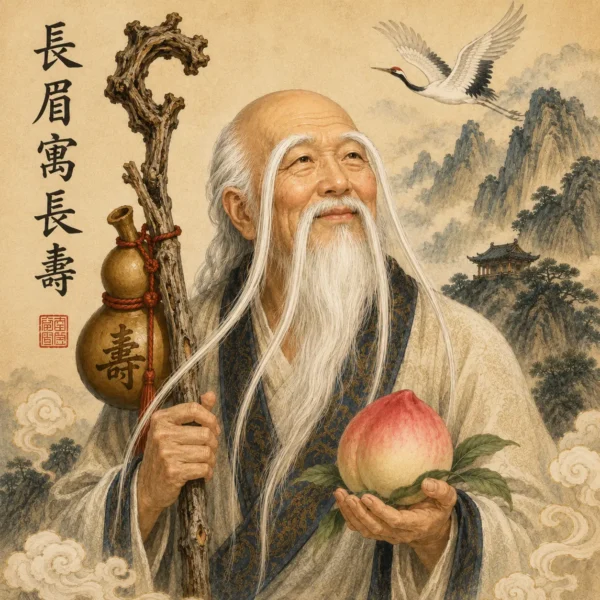
Shouxing is usually portrayed as a smiling elderly man with:
- a large domed forehead,
- flowing white beard,
- robes of an immortal sage,
- a walking staff,
- peaches of immortality,
- and extraordinarily long white eyebrows.
These features are symbolic rather than realistic. The enlarged forehead represents wisdom and accumulated knowledge. The peaches refer to immortality legends connected to heavenly orchards. The long eyebrows indicate advanced age and spiritual attainment.
Images of Shouxing became especially popular during birthdays of elderly family members. Decorations featuring the deity are still commonly displayed at celebrations for people reaching advanced ages such as seventy, eighty, or ninety years old. In this context, the long eyebrows function as blessings and aspirations rather than literal descriptions.
In some traditions, Shouxing is linked to the star Canopus, known in Chinese astronomy as the “Old Man Star.” Because the star was associated with long life and favorable destiny, the deity absorbed astronomical as well as folkloric symbolism.
Mountain Hermits and Daoist Sages: Beyond formal religious iconography, Chinese folklore contains countless tales of mysterious mountain hermits with long eyebrows.
These figures are often portrayed as withdrawn from ordinary society and living in remote forests or mountain temples. Travelers encounter them unexpectedly and discover that the strange old man possesses hidden wisdom or supernatural insight.
In some stories, the hermit appears physically frail but demonstrates astonishing vitality. In others, he offers cryptic advice that later proves life-saving. Occasionally he vanishes after the encounter, revealing himself to have been an immortal or spirit rather than an ordinary human.
The long eyebrows serve several narrative functions:
- they identify the figure as ancient,
- distinguish him from ordinary people,
- and visually reinforce the idea of accumulated wisdom.
The eyebrows sometimes become exaggerated to supernatural proportions, hanging to the chest or shoulders. Such imagery emphasizes that the individual exists outside normal human limits.
Chinese painters frequently depicted Daoist immortals in this style. Long brows flowing beside equally long beards created visual cues immediately recognizable to viewers familiar with longevity symbolism.
The Symbolism of White Hair: The whiteness of the eyebrows is also important. In Chinese symbolism, white hair often carries positive associations with age, continuity, and ancestral authority.
Unlike some modern societies that emphasize youthfulness above all else, traditional Chinese culture often placed substantial value on longevity and elder status. Elderly individuals were respected as living repositories of family memory, practical experience, and moral guidance.
As a result, signs of advanced age could become honorable rather than undesirable. Long white eyebrows therefore symbolized not merely biological aging but successful survival through decades of hardship and change.
The image of the elderly sage with white brows communicated stability and wisdom in a rapidly changing world.
Folklore, Humor, and Exaggeration: Not all long-eyebrow stories were solemn or religious. Some folk tales used exaggerated eyebrows humorously.
In certain stories, the eyebrows become so long that servants must tie them back, or the old man accidentally treads on them while walking. Other tales involve mistaken identity, where a traveler assumes an old man is an immortal solely because of his extraordinary brows.
Chinese opera and folk theater also embraced these visual conventions. Actors portraying immortals or ancient advisors often wore dramatic white eyebrow extensions. Audiences instantly understood the symbolism without any explanation being necessary.
This blend of reverence and humor helped keep the imagery alive within popular culture.
Connections across East Asia: Eyebrows have cultural significance in many societies, but typically the main focus through history was on plucking and shaving eyebrows to meet cultural expectations. Long eyebrow hair and its positive cultural significance is relatively unique to China. Over time, the symbolism of long eyebrows spread beyond China into neighboring cultures influenced by Chinese art and philosophy.
Japanese depictions of elderly sages and immortals sometimes include similar elongated brows. In Japanese folklore, the “long-browed old man” became another recognizable sign of wisdom and age. Korean artistic traditions also absorbed related imagery over several centuries.
Because Daoist and Buddhist artistic traditions circulated widely across East Asia, visual motifs associated with longevity became internationally recognizable. Even today, animated films, martial arts stories, and fantasy illustrations often portray wise masters with flowing eyebrows descended from these ancient artistic conventions.
Biological Reality Behind the Myth: Interestingly, the folklore was not entirely disconnected from observable biology.
Eyebrow growth is governed by hormonal regulation and hair follicle cycling. Normally, eyebrows are slow growing with a short growth period, consequently, they generally remain quite small. However, in some elderly individuals, especially men, certain eyebrow follicles remain in prolonged anagen growth phases, allowing hairs to grow much longer than usual. Changes in androgen hormone sensitivity and follicular aging may contribute to the phenomenon.
Similar effects can occur with ear and nasal hair during aging. Ancient observers, lacking modern biological explanations, interpreted these unusual features symbolically.
Although very long eyebrows do not actually predict lifespan, the visible association between advanced age and eyebrow elongation likely reinforced the folklore repeatedly over centuries.
Why the Symbol Endures: The enduring popularity of the long-eyebrow elder reflects something universal in human culture: fascination with longevity.
Every society develops symbols representing wisdom, endurance, and survival beyond ordinary limits. In Chinese culture, long white eyebrows became one of the most distinctive visual expressions of these ideas.
The symbolism also reflects traditional Chinese philosophical values. Longevity was not merely about avoiding death. Ideally, a long life was supposed to represent balance, moderation, spiritual cultivation, family continuity, and alignment with natural rhythms.
The long-browed elder therefore symbolized more than age alone. He represented a life successfully lived.
Even in modern China, the image remains culturally recognizable. Birthday cards, New Year decorations, temple art, and television dramas still feature elderly figures with elongated white brows. Contemporary audiences may not consciously analyze the symbolism, yet the association with wisdom and long life persists.
What began as observations of aging hair growth evolved into one of East Asia’s most enduring symbols of longevity. The old man with the long eyebrows continues to stand at the intersection of folklore, religion, art, medicine, and cultural memory; a reminder that even the smallest features of the human body can become transformed into powerful mythic symbols across generations.
Bibliography